 Engineering Education
Magazine
Engineering Education
MagazinePresident’s Letter: A Natural Role
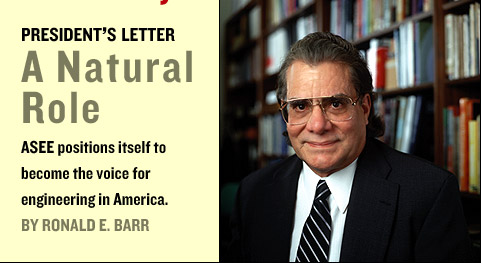
As I write my last letter for Prism, I reflect on the tremendous privilege it has been to serve as ASEE president this past year. I have gone many places and met many fine people who are all immensely dedicated to our common goals. During my travels across the country, I have heard people express concern that America’s global superiority in engineering and technology is in danger. The effects of globalization on engineering, both in education and practice, are clearly present and cannot be ignored.
Numerous national reports that have surfaced in the past two years suggest our nation must aggressively reinvest in science, engineering and technology to continue our global competitiveness. One report in particular, “Rising Above the Gathering Storm,” has gained traction in the inner circles of the federal government. The report calls for national reinvestment in four basic areas: improving K-12 science and math education; increased basic research in the physical sciences; immigration laws that attract the best and brightest; and tax credits for corporate research and development in basic science and engineering.
The ASEE Board met in January in San Antonio for a full day of long-range planning. With help from our good friends at Hewlett-Packard, a professional facilitator was brought in to conduct the planning session. This stimulating event helped us focus on strategies that not only improve ASEE but also address the national imperative to vigorously promote engineering and technology in America. That same weekend, the ASEE Board unanimously endorsed the “Gathering Storm” report. On Feb. 14, ASEE’s Engineering Deans Council met at the National Academies building in Washington, D.C., to discuss and support key legislative efforts aimed at improving American competitiveness in science and technology. The next day, bolstered by addresses from Secretary of Energy Samuel Bodman and U.S. Sens. Jeff Bing-aman (D-N.M.) and Lamar Alexander (R-Tenn.), the engineering deans visited their own congressional leaders to promote science and technology legislation.
Two weeks later, ASEE’s Engineering Research Council (ERC) met in Crystal City, Va., outside Washington, to hear about new research-funding opportunities in the physical sciences and engineering. Many of the talks from the National Science Foundation, the National Institutes of Health, the Department of Defense and other federal agencies focused on the need for America to invest more in research. At this ERC forum, I was particularly struck by one comment made by an NSF program director. When asked what national group speaks for engineering in America, he suggested that “ASEE might be in the best position” to wear that leadership mantle.
ASEE is now a key participant in the Innovation and Competitiveness Coalition, whose members include industry, academia and nonprofit organizations in the science, technology, engineering and mathematics sectors (STEM). The Innovation Coalition is a group committed to maintaining U.S. global leadership in innovation, strengthening American competitiveness, improving the education of Americans in the STEM areas and expanding the technological literacy of the American public.
As ASEE increases its strategic planning, we must ask ourselves: How can ASEE play a leadership role in support of national engineering priorities? With over 45 divisions spanning all engineering disciplines and special interest groups, ASEE has the breadth to speak for engineering. Our new K-12 Center and accompanying initiatives can help plant science and engineering seeds in the nation’s youth and reach out to parents and the public. The ASEE Corporate Member Council provides opportunities to unite with industry to support American competitiveness issues, such as the “Gathering Storm” report. Yet, we must do more to promote a positive engineering image in the U.S. media—through newspaper editorials, with specialty magazines and video downloads, on public radio and in television interviews.
Finally, might we also speak for engineering education as a basic foundational value for America? Engineering education imparts to the graduate a host of analytical, communication and social skills that are needed to solve the many complex problems the nation faces. Can we think of unleashing a new generation of citizens in America with these engineering skills? As ASEE accepts this leadership role, it is up to all of us to be that “voice” for engineering in America, no matter how large or small the stage.
Ronald E. Barr is president of the American Society for Engineering Education. He is also a professor of mechanical engineering at the University of Texas–Austin.
ASEE Board of Directors – 2006 Election Results
ASEE members elected James L. Melsa as ASEE president-elect for 2006-2007. Melsa is dean emeritus of the College of Engineering at Iowa State. He will assume the position of ASEE president-elect at the 2006 Annual Conference and become president the following year.
Full election results for all ASEE offices are as follows:
President-Elect:
James L. Melsa (534 votes)
Dean Emeritus of the College of Engineering
Iowa State University
Frank M. Croft (414 votes)
Associate Professor
Civil & Environmental Engineering & Geodetic Science
Ohio State University
Vice President, Member Affairs:
J. P. Mohsen (503 votes)
Professor & Chair
Civil & Environmental Engineering
University of Louisville
Tom C. Roberts (419 votes)
Assistant Dean of Engineering
Kansas State University
Chair, Professional Interest Council I:
John Lamancusa (558 votes)
Professor, Mechanical Engineering &
Director of the Learning Factory
Pennsylvania State University
Jerome P. Lavelle (312 votes)
Assistant Dean of Academic Affairs &
Associate Professor of Industrial Engineering
North Carolina State University
Chair, Professional Interest Council IV:
Mary R. Anderson-Rowland (638 votes)
Professor
Industrial Engineering
Arizona State University
Eugene F. Brown (244 votes)
Professor
Mechanical Engineering
Virginia Tech
Chair, Professional Interest Council V:
David H. Quick (458 votes)
Manager, R&D Customer Requirements
Alliance Advanced
Development Company
Rolls-Royce Corp.
Daniel Marcek (380 votes)
Deputy Director
Hewlett-Packard University Relations
Chair-Elect, Zone I:
John A. Stratton (117 votes)
Professor & Program Chair
Electrical/Mechanical
Engineering Technology
Rochester Institute of Technology
Harold N. Knickle (93 votes)
Professor
Chemical Engineering
University of Rhode Island
Chair-Elect, Zone III:
Ralph E. Flori (118 votes)
Assistant Dean of Engineering
& Associate Professor of Interdisciplinary Engineering
University of Missouri-Rolla
Charles McIntyre (70 votes)
Associate Professor & Chair
Construction Management
& Engineering
North Dakota State University
ENGINEERING DEANS COUNCIL – KEEPING COMPETITIVE
This year’s Engineering Deans Council (EDC) Public Policy Colloquium, which took place Feb. 14 and 15 in Washington, D.C., focused on national security and American competitiveness. Approximately 100 deans of engineering from 39 states, the District of Columbia and Puerto Rico attended the event. The colloquium, entitled “Engineering Colleges in Service to America,” featured keynote addresses from Sen. Jeff Bingaman (D-N.M.) and Secretary of Energy Samuel Bodman. On the second day of the colloquium, the deans divided into state groups and visited with their congressional delegations.
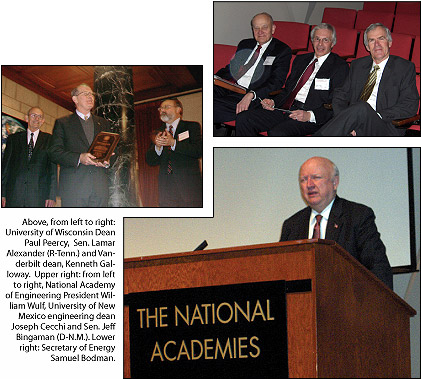
In the congressional keynote address, Bingaman discussed the growing concern over the future of American competitiveness with countries that are educating an increasing number of engineers and the legislation he has introduced to address those concerns. “The PACE Act stresses the importance of filling the pipeline of students for the year 2020 and beyond,” he said. “It also stresses the importance of innovation by increasing R&D budgets, enhancing patent protection, keeping university research free from counterproductive export control regulations, streamlining visa processing and improving tax incentives to keep cutting-edge R&D here in the United States.”
In the Executive Branch keynote address, Secretary of Energy Samuel Bodman discussed the American Competitiveness Initiative proposed by President Bush. “This initiative recognizes two fundamental truths: that, in order to maintain our economic preeminence, we must maintain our scientific and technological superiority; and that doing so requires a substantial and sustained investment,” he said. “The bottom line is this: The president recognizes that science and technology will lead us to cleaner and better sources of energy, to new ways to heat our homes, to power our cars, to run our businesses, to preserve our environment and, therefore, to ensure a more secure, safer future. It is a big challenge for American science and engineering.”
Other speakers included William Wulf, president of the National Academy of Engineering; Don Giddens, Georgia Institute of Technology; C.D. Mote, president of the University of Maryland; and Richard O. Buckius, acting assistant director for engineering at the National Science Foundation.
The colloquium also featured a panel discussion on FY 2007 science and technology budget considerations with Kei Koizumi, director, R&D Budget and Policy Program at the American Association for the Advancement of Science; Jeffrey Mervis, a reporter from Science magazine; and Jennifer Poulakidas from the University of California.
The deans presented this year’s Engineering Deans Council Appreciation Award to Sens. Lamar Alexander (R-Tenn.) and Bingaman (D-N.M.) for their efforts in initiating the National Academies report “Rising Above the Gathering Storm.” In Alexander’s acceptance speech, he stressed the importance of the deans staying in contact with their congressional delegations.
On Feb. 15, the deans visited Capitol Hill to meet with members of Congress and their staff members. Most of the policymakers seemed supportive of research and development and science and technology funding in the FY 2007 budget. —Robert F. Malgieri
Call for Nominations
The ASEE Nominating Committee, chaired by Most Immediate Past President Sherra E. Kerns, requests member participation in nominating board officers for the 2007 ASEE elections. Officers to be nominated for society-wide positions are: president-elect; vice president for public affairs; vice president for finance; chair PIC II; and chair PIC III.
All nominees must be individual members or institutional member representatives of ASEE at the time of nomination and must maintain ASEE membership during their term of office. Nominating Committee members are not eligible for nomination. The slate of candidates selected by the committee will not exceed two candidates per office.
Candidates for president-elect must be active members who have served or are serving on the Board of Directors. Candidates for vice president for public affairs must be active members who have served at least two years on the Projects Board. Candidates for vice president for finance must be active individual members or institutional member representatives of ASEE.
Candidates for chair of the Engineering Deans Council, chair of the Corporate Member Council and chair-elect for Zone II and Zone IV will be nominated and selected by their respective councils and zones, as the ASEE constitution stipulates.
Each proposed candidate for a society-wide office must submit a biographical sketch of fewer than 400 words that documents career contributions, ASEE offices held, awards and recognitions received and educational background. Information on leadership qualities, ability to cooperate with others to achieve objectives and willingness to serve if elected must be included. A listing of members who meet constitutional eligibility requirements for the offices of president-elect and vice president for public affairs is available from the executive director’s office at ASEE headquarters.
Send nominations in writing, marked confidential, by May 30. For nominations for the office of president-elect, please include an advocacy statement. Mail nominations to Sherra E. Kerns, Chair, ASEE Nominating Committee, ASEE, 1818 N Street, N.W., Suite 600, Washington, DC 20036.
ABOUT PEOPLE
Patrick Farrell, executive associate dean of the University of Wisconsin-Madison College of Engineering, has been named UW-Madison’s new provost and vice chancellor for academic affairs.
Past ASEE President Cary Fisher retired in December after 42 years of service in the Air Force. Fisher spent 32 of those years at the Air Force Academy, where he served as professor and engineering division chair and earned a Cadet Plaque and Saber, the academy’s highest award. Among other positions, Fisher has been project engineer at the Air Force Weapons Lab in Albuquerque, N.M., and, most recently, senior U.S. military liaison officer to the United Nations mission in Kosovo.
ASEE member and chemical engineering professor Joel O. Hougen passed away Feb. 6, leaving behind four children, 13 grandchildren and three great-grandchildren. Hougen, who earned his B.S. from the University of Wisconsin and his Ph.D. from the University of Minnesota, was professor emeritus at the University of Texas in Austin. During his career, Hougen also taught at Rensselaer Polytechnic Institute and worked in the industry and as a private consultant.
Gerald S. Jakubowski, vice president of Arizona State University, provost of the ASU Polytechnic campus and professor of engineering, has been selected as 13th president of Rose-Hulman Institute of Technology.
Leah H. Jamieson, associate dean in Purdue’s College of Engineering and Ransburg Professor of Electrical and Computer Engineering, has been appointed to serve as interim dean of the college.
Purdue University’s dean of engineering, Linda P.B. Katehi, has been named provost and vice chancellor for academic affairs at the University of Illinois at Urbana-Champaign.
Princeton’s dean of engineering, Maria Klawe, has been chosen as the fifth president of Harvey Mudd College. Klawe will be the first woman to serve as president at Harvey Mudd.
When Ron Paré, current chair of the Engineering Design Graphics Division, achieved Life Member status in April, he became ASEE’s first known Life Member son of a Life Member father. Ron’s father, the late Eugene Paré, had been a member of ASEE for 57 years at the time of his passing.
Duke engineering professor Henry Petroski has been honored with the 2006 Washington Award, one of the oldest and most prestigious engineering awards in the country, for his accomplishments in making engineering theory and practice understandable to the general public. Petroski is the Aleksandar S. Vesic Professor of Civil and Environmental Engineering at Duke, as well as the author of the Prism column Refractions. The award is presented by a commission of seven engineering societies to an engineer whose professional attainments “pre-eminently advance the welfare of humankind.”
New NAE Members
The National Academy of Engineering elected 11 ASEE members as new members and one ASEE member as a foreign associate in recognition of their outstanding contributions to engineering research, practice or education.
Ilesanmi Adesida, interim dean, College of Engineering, University of Illinois, Urbana-Champaign. For contributions to the nanometer-scale processing of semiconductor structures and applications in high-performance electronic and optoelectronic devices.
Cristina H. Amon, Raymond J. Lane Distinguished Professor and director, Institute for Complex Engineered Systems, Carnegie Institute of Technology, Carnegie Mellon University, Pittsburgh. For advances in heat transfer and thermal design of portable electronics and for contributions to engineering education.
Mark A. Barteau, Robert L. Pigford Professor and chair, department of chemical engineering, University of Delaware, Newark. For advancing the fundamental understanding of surface chemical-reaction mechanisms and for the design and invention of new catalysts.
Vijay K. Dhir, distinguished professor and dean, Henry Samueli School of Engineering and Applied Science, University of California, Los Angeles. For work on boiling heat transfer and nuclear reactor thermal-hydraulics and safety.
Linda P.B. Katehi, dean of engineering, Purdue University, West Lafayette, Ind. For contributions to three-dimensional integrated circuits and on-wafer packaging and contributions to engineering education.
Pradeep K. Khosla, dean of engineering and Phillip and Marsha Dowd Professor, Carnegie Mellon University, Pittsburgh. For contributions to design and sensor-based control in robotic systems for the assembly of high-precision electronics and for leadership in engineering education.
John H. Linehan, vice president, The Whitaker Foundation, Arlington, Va. For research on the pulmonary mechanics and metabolism of critical bioactive agents and for innovations in bioengineering education and professional development.
Nicholas A. Peppas, Fletcher Stuckey Pratt Chair in Engineering, University of Texas, Austin. For contributions to the development of biomedical and drug-delivery applications of polymer networks and hydrogels.
William S. Saric, professor of aerospace engineering, Texas A&M University, College Station. For contributions to the fundamental understanding and control of shear flow and boundary-layer transition.
Ali Galip Ulsoy, William Clay Ford Professor of Manufacturing, University of Michigan, Ann Arbor. For research on the dynamics and control of axially moving elastic materials and their implementation in automotive and manufacturing systems.
G. Paul Willhite, Ross H. Forney Distinguished Professor and chair co-director, Tertiary Oil Recovery Project; and co-director, Kansas University Energy Research Center, University of Kansas, Lawrence. For research, technology and education outreach in tertiary oil-recovery processes.
New Foreign Associate
Kuang-Di Xu, president, Chinese Academy of Engineering, Beijing. For contributions to the efficient manufacturing of quality steels with minimal environmental impact.
Section Meeting Proceedings
To download the proceedings and photos from the ASEE Mid-Atlantic Section Fall 2005 Conference at Stony Brook University (Stony Brook, NY, Oct. 28-29, 2005), please visit:
http://mpg.matscieng.sunysb.edu/asee/index.htm.
UPADI Conference
Sept. 19 – 22, 2006, Atlanta, Ga.
Through the context of global trade, ethical practices and economic development, gain an international perspective on engineering and business practices throughout Central and South America at UPADI 2006. Advance your professional growth and discover business opportunities through plenary sessions led by industry thought leaders and technical congresses by practicing engineers. For more information: http://www.upadi2006.com.
2007 ASEE Annual Conference & Exposition Calls for Papers
The American Society for Engineering Education invites authors to submit abstracts for the 2007 ASEE annual conference, to be held in Honolulu, Hawaii, June 24 – 27.
Abstract submission will open in August 2006. An author’s kit with deadlines and instructions will be available through SmoothPaper and on the 2007 conference Web site this summer. All abstracts must be submitted through SmoothPaper (www.asee.org/SmoothPaper/).
AEROSPACE DIVISION
The Aerospace Division invites abstracts on topics of interest to aerospace engineering and engineering technology by all engineering and technology faculty and students. The division seeks abstracts that include, but are not limited to, the following topics:
• How to teach rapidly evolving subjects spread across disciplines
• Role of integrated projects in the aerospace curriculum
• Enhancing communication and team skills in aerospace engineering/technology
• Undergraduate-industry-research linkages: What works; what doesn’t?
• Research on learning relevant to aerospace engineering
• The role of aerospace engineering education in a global workplace
Accepted abstracts authors will be invited to prepare a draft paper for peer review for publication in the conference proceedings. The Aerospace Division requires that a paper be accepted for publication in the conference proceedings in order for it to be presented at the conference.
Details for abstract submission via SmoothPaper will be posted on the ASEE Web site in the near future. For further information, contact the ASEE 2006 Aerospace program chair, Narayanan Komerath, Georgia Institute of Technology at komerath@gatech.edu.
ARCHITECTURAL ENGINEERING
DIVISION
The Architectural Engineering Division seeks papers from academia and industry related to architectural and construction engineering, engineering technology and building science. Topics may include cooperative efforts between education and industry, innovative teaching methods (outside the box), curricula, international education and teaching experiences, integrating design into the curriculum, using the new technology in the classroom, co-ops and internships, case studies, capstone projects, research and assessment. Pure technical papers that have no educational component or application will most likely not be accepted. The Architectural Engineering Division has a publish-to-present requirement.
For more information, contact the program chair: John J. Phillips, Oklahoma State University School of Architecture, 101 School of Architecture, Stillwater, OK 74078; (405) 744-9064; e-mail: john.j.phillips@okstate.edu.
BIOMEDICAL ENGINEERING DIVISION
The Biomedical Engineering Division (BED) of ASEE invites papers for the 2007 annual conference. Engineers in academia and industry from across the world should consider submitting a paper that focuses on biomedical engineering education.
The topics listed below are intended to serve as a guide for authors. However, authors are encouraged to submit papers on any relevant topic on biomedical engineering education for inclusion in the BED portion of the conference:
1. Problem-based learning in biomedical engineering
2. Textbooks and teaching strategies in biomedical engineering
3. Simulation courses and biomedical engineering laboratories
4. Education for emerging areas in biomedical engineering
5. Industry-sponsored projects
6. Ethical issues in biomedical engineering education
7. Best practices for assessing biomedical engineering education
In order to present your work at the conference, an abstract and full paper must be submitted and accepted.
Abstracts and papers will be judged based on the level of innovation, technical merit, demonstrated outcomes and relevance to biomedical engineering, science and technology education. All abstracts and papers must be submitted electronically via the ASEE’s SmoothPaper Web site. You can access conference information and submit via the main ASEE Web site, www.asee.org.
Questions regarding the abstract or paper submission can be directed to the Program Chair, Ann Saterbak (saterbak@rice.edu or (713) 348-6243) at Rice University.
CHEMICAL ENGINEERING DIVISION
The Chemical Engineering Division invites submissions of papers on topics relevant to chemical engineering education. Topic areas include, but are not limited to, the following:
Curriculum Topics
• The Future of Chemical Engineering Education
• Curriculum Revision and Enhancement
• Nontraditional Applications in Chemical Engineering
• Innovative Freshman or Sophomore Pre-professional Courses or Experiences
• Incorporation of Safety, Ethics and the Environment
Departmental/Faculty Topics
• ABET Processes
• Program Outcomes & Assessment
• Contemporary Faculty Issues
• Mentoring New Faculty
• Professional Development Opportunities in Education
Course Topics
• ChE Experiences in Innovation, Design and/or Industrial Projects
• Managing Capstone Courses
• Innovative Approaches to Improving Learning in the Laboratory
• Innovative Approaches to Improving Learning in the Classroom
• New Course Development (Required or Elective)
Student Topics
• Advising and Career Development Issues
• Nontraditional and Underrepresented Student Populations
• Recruitment, Outreach and Retention
• Mentoring Undergraduate Students in Research
Those interested in proposing workshops should contact the program chair directly.
For more information, contact the program chair: Randy S. Lewis, Department of Chemical Engineering, Brigham Young University, 350 CB, Provo, UT 84602; (801) 422-7863; e-mail: randy.lewis@byu.edu.
CIVIL ENGINEERING DIVISION
The Civil Engineering Division invites submission of abstracts on any topic related to civil engineering education.
Abstracts should be approximately 500 words in length and should provide a clear statement of the objective, its relevance to the civil engineering community, assessment methods and results.
Authors of accepted abstracts will be invited to prepare a full paper for peer review for publication in the conference proceedings. Papers must demonstrate an appropriate level of scholarship. With the exception of invited panels, the Civil Engineering Division requires that a paper be accepted for publication in the conference proceedings if it is to be presented at the annual conference (publish-to-present).
For more information, contact Kristen Sanford Bernhardt, Department of Civil and Environmental Engineering, Lafayette College, Easton, PA 18042; (610) 330-5584; sanfordk@lafayette.edu.
COMPUTERS IN EDUCATION DIVISION
The Computers in Education Division invites papers for the 2007 ASEE annual conference. The program committee has identified the focus areas listed below, but outstanding papers on other topics related to computers in engineering education will also be considered.
• Computer science education for engineers, especially curricula and first-year courses
• Instrumentation and laboratory systems, including data acquisition
• Mobile robots, impacts on engineering and computer science education
• Mobile computing (PDA, laptop, tablet PC, etc.) applications and ramifications in education
• Embedded computing, including microprocessor and microcontroller selection and applications
• Software packages, including symbolic computing and equation solvers
• Digital signal processing (DSP), including hardware/software for embedded systems
• Simulation and animation, including algorithms and artificial intelligence
• Computer architecture, including hardware descriptive languages
• Internet applications in classroom and lab, including automated evaluation systems
Persons interested in proposing a workshop through CoED should contact the program chair (listed below) for information.
Criteria for Selection/Publication:
The Computers in Education Division uses the publish-to-present rule for the ASEE annual conference. The two-step review process will consist of an abstract review, followed, if favorable, by a full manuscript review. Acceptance of the work at both stages of review is necessary for presentation in CoED sessions. Abstracts are judged on level of innovation, technical merit, demonstrated outcomes and relevance to engineering, science and technology education. Complete manuscripts will be judged on these same criteria as well as on accuracy, completeness, readability and rigor of presentation. The CoED program will consist of conventional technical sessions as well as one or more poster sessions. All presenters are expected to register for and attend the conference.
Submissions:
Prospective authors should submit an electronic abstract of 300-400 words to the ASEE paper submission Web site. See www.asee.org for exact due date and URL. At the submission Web site, authors can direct their abstract to the Computers in Education Division (CoED). Abstracts should not be sent directly to the CoED program chair.
Awards:
Every paper accepted for publication and presentation at a CoED session is eligible for one or more of the following awards:
• Woody Everett Poster Session Award
• John A. Curtis Lecture Award
Each award consists of a plaque, a certificate and a cash prize.
Computers in Education Division Program Chair: Steven F. Barrett, Ph.D., P.E., Associate Professor, Electrical and Computer Engineering, College of Engineering, University of Wyoming, Dept. 3295, 1000 E. University Ave., Laramie WY 82071; (307)766-6181; e-mail: steveb@uwyo.edu.
CONSTRUCTION ENGINEERING DIVISION
The Construction Engineering Division of ASEE invites abstracts (and subsequent full papers) for presentation (and publication) at the ASEE annual conference. Here is a great chance for having your construction engineering education-related work peer reviewed and published in an internationally known engineering education conference. The paper could be in any area of construction engineering, construction management, cost engineering or any other related area. The paper must include engineering education issues. The Construction Engineering Division is publish-to-present division. You must have your full paper accepted by the peer reviewers to present in the conference.
Please contact Amit Bandyopadhyay, P.E., Program Chair, Construction Engineering Division. Architecture and Construction Management Department, Farmingdale State University of New York (bandyoa@farmingdale.edu or (631) 420-2378) for any question or clarification
CONTINUING PROFESSIONAL
DEVELOPMENT DIVISION
The Continuing Professional Development Division (CPDD) invites you to submit abstracts that address innovative programs and teaching techniques in continuing and distance education. The CPD division is particularly interested in the following topics:
• Successful partnerships between community colleges and four-year institutions in the offering of engineering education courses/programs
• Development and administration of international engineering education programs
• Industry and academic partnerships: lessons learned and recommendations for developing new partnerships
• Development of undergraduate distance education degree programs in engineering and computer science
• Innovative teaching strategies designed to meet the needs of adult learners
For more information, contact the CPDD Program Chair Linda Krute at North Carolina State University, College of Engineering, 256 Page Hall, Raleigh, NC 27695; (919) 515-5440; e-mail Linda_Krute@ncsu.edu.
COOPERATIVE EDUCATION DIVISION
The Cooperative Education Division (CED) invites papers for presentation at the 2007 ASEE annual conference. All abstracts must be submitted through the ASEE SmoothPaper submission system, via www.asee.org/smoothpaper. Each abstract should be 250 – 500 words long and should be submitted following the instructions in the Author’s Kit, which will be available through SmoothPaper and the ASEE Web site. Authors may not submit the same abstract to multiple divisions. This year, CED does not have a publish-to-present requirement, so all are encouraged to submit an abstract. The deadline for submission will be announced on the ASEE Web site.
Engineers or cooperative education advisers from either academia or industry should consider submitting papers that are relevant to cooperative education and work-integrated learning. Suggested topics include, but are not limited to:
• Socialization of engineering students in the workplace
• Preparing engineering students for work in the 21st century
• Benchmarking of co-op programs by universities and employers
• Developing international opportunities for co-op students
• Collaborative efforts between industry and academia
• International co-op and internship programs
• The federal government and co-op
• Co-op collaboration with engineering departments
• Co-op and its importance to ABET
For further information, please contact Craig Gunn, Director, Communication Program–Department of Mechanical Engineering, Michigan State University, at gunn@egr.msu.edu or by phone at (517) 355-5160.
DESIGN IN ENGINEERING
EDUCATION DIVISION
The Design in Engineering Education Division (DEED) invites papers for presentation and publication at the June 2007 annual conference. Papers may be submitted on topics related to the role of design in engineering education. The following topics are of particular interest:
• Capstone Design
• Design for Industry/Manufacturing
• Innovation in Design Education
• Teaching Design
• Teams and Teamwork in Design
Education
• Design for Community
• Multidisciplinary Design
• Using IT to Enhance Design Education
• Designing for “X”
• Relationships Between Design, Assessment and ABET EC2000
Proposals for new session topics and session formats are also encouraged.
Please indicate on the top of your abstract which topic or session you feel your paper will fit best, and DEED will make every effort to place it in the correct session.
Please also note that the division requires submission of the full, final version of the paper in order for a paper to be accepted for presentation at the conference in either a technical or poster session, as well as for publication in the proceedings.
A poster session might be used to accommodate papers that do not fit into a session but are worthy of publication in the proceedings.
For more information contact the program chair: Amir Rezaei, Mechanical Engineering, California State Polytechnic University, Pomona; (909) 869-2590; e-mail: arezaei@csupomona.edu; or past program chair Rudy J. Eggert, Mechanical Engineering, Boise State University, (208) 426-4810; e-mail: reggert@boisestate.edu.
DIVISION OF EXPERIMENTATION AND
LABORATORY-ORIENTED STUDIES
The Division of Experimentation and Laboratory-Oriented Studies (DELOS) invites abstracts for papers for the 2007 ASEE annual conference.
DELOS is a multidisciplinary division devoted to laboratory innovations for instruction and experimentation. Papers addressing, but not limited to, the following topics are requested:
• Computer-assisted data acquisition
• Virtual and distance experiments
• The use of the Internet in executing experiments and laboratories
• Unique, multidisciplinary laboratory experiments and programs
• Laboratory exercises or design projects that use systems such as the Lego® RCX, etc.
• Horizontal or vertical curricular integration of laboratory experiments and courses
• The pedagogy of laboratory courses
DELOS sponsors three (3) Best Paper Awards consisting of plaques and cash prizes. All papers submitted to the division will be considered for these awards.
Abstracts must be submitted electronically through the ASEE Web site, www.asee.org/smoothpaper. DELOS is a publish-to-present division. Acceptance of abstracts in the division does not ensure publication in the conference proceedings or presentation at the conference. A final, peer-reviewed paper, based on the abstract, must be approved before it can be included in the proceedings or presented at the conference.
For more information, contact DELOS-2007 Program Chair, Brian Lefebvre; (856) 256-5338; e-mail: Lefebvre@rowan.edu or DELOS-2007 Division Chair, Bijan Sepahpour; (609) 771-3463; e-mail: sepahpou@tcnj.edu.
EDUCATIONAL RESEARCH AND
METHODS DIVISION
The Educational Research and Methods Division (ERM) seeks papers and workshop proposals on topics related to ERM’s primary objectives. These objectives include the dissemination of knowledge on learning and teaching; the encouragement of efforts to improve instruction through development of innovative materials and techniques, sound instructional design and improved evaluation methodology; and the enhancement of the status of teaching in the university and beyond. Papers are invited on topics such as active and cooperative learning, advanced classroom technologies, attracting and retaining a diverse population of students, evaluation and outcomes assessment, the design of learning environments and technologies, historical perspectives and lessons, integrated and nontraditional curricula, lifelong learning, new learning models and applications, research and the classroom and teaching the art and science of teaching. ERM is a publish-to-present division, that is:
• Acceptance of a peer-reviewed abstract leads to the invitation to submit a full paper.
• Acceptance of the final paper will depend on a successful peer review of the full paper. Papers should include relevant assessment information, as a rigorous review can be expected. Incomplete papers will not be accepted.
• Only full papers will be considered for presentation.
• A presentation of the paper at the annual conference is required for publication.
• All abstracts, and ultimately full papers, must be submitted through ASEE’s SmoothPaper system.
Abstracts for Papers:
Abstracts should be no more than 500 words in length and should contain sufficient information to enable the ERM Vice Chair for Programs and the reviewers to determine its suitability for presentation in the ERM Division. The ERM Division uses a blind review process when reviewing its abstracts and papers. Therefore, please omit author information from the abstract itself.
Your abstract should be written to address the following:
• Background and Motivation
• What was done? (Methods used and why?)
• Results (include some data and analysis if appropriate; what was found?)
• Conclusions and Significance (including wider application)
• You should not include references in the abstract
If your abstract is accepted for the conference, you will be required to submit a full manuscript that will be evaluated by the criteria shown below. These criteria are intended to assist the author in crafting a paper that would have the widest possible appeal to the ERM Division and be of lasting value to the engineering education community. Manuscripts exhibiting strength in only a subset of these criteria may still be deemed acceptable based upon the nature and quality of the material. Manuscripts fulfilling only a few (to none) of the criteria will be deemed less desirable.
• To what extent does the manuscript explore creative and original concepts?
• How well conceived and organized is the manuscript?
• How well does the manuscript advance discovery and understanding while promoting teaching, training and learning?
• How well does the manuscript present a significant research question that appeals to a broad group of people interested in engineering education?
• How well does the manuscript present a research question that was investigated empirically?
• In what ways does the manuscript build upon relevant references and bodies of knowledge?
• In what ways does the manuscript describe appropriate educational or scientific principles?
• Are appropriate methodologies used to answer/address the research question?
• How well does the manuscript provide a coherent and explicit chain of reasoning?
• To what extent can the results of the study be generalized to other educational settings or to new theory?
Abstracts for Workshops:
Workshop proposals are handled separately from papers. These should not be submitted through SmoothPaper but should be sent directly to the ERM Vice Chair for Programs. The workshop decisions are made before the paper abstracts are reviewed. Thus, it is essential that anyone wishing to present a workshop contact the ERM Vice Chair for Programs immediately. For more information, contact: Cindy Finelli, University of Michigan, ERM Vice Chair for Programs 2006, Center for Research on Learning and Teaching North, 1071 Palmer Commons; 100 Washtenaw Ave., Ann Arbor, MI, 48109-2218; (734) 764-0244; fax (734) 647-3600; e-mail: cfinelli@umich.edu.
ELECTRICAL AND COMPUTER
ENGINEERING DIVISION
The Electrical and Computer Engineering Division seeks abstracts for papers to be presented at the 2007 ASEE annual conference. Topics of particular interest include: curricular and design innovations, laboratory development and innovation, asynchronous and Web-based teaching and learning techniques, undergraduate research, assessment of teaching and learning, novel methods for implementing ABET Engineering Criteria 2000, globalization of engineering education and pedagogical issues arising from the emergence of new areas such as bioengineering and life sciences, information engineering/technology, wireless and broadband communications, optoelectronics and nanotechnology. Other topics of general interest in electrical and computer engineering education/research will also be considered.
Abstracts of 200-300 words must be submitted electronically through the ASEE SmoothPaper system (www.asee.org/SmoothPaper/). Authors of accepted abstracts will have the opportunity to submit a full paper, which will be peer-reviewed for possible inclusion in the conference proceedings. Papers must be submitted and accepted for presentation in order to present at the conference. Proposals for special paper sessions or panel discussion should be submitted to Dennis Silage, ASEE ECE Division, at silage@temple.edu. Individuals interested in organizing/moderating a session or participating in the peer-review process should contact Professor Silage for additional information.
ENERGY CONVERSION AND
CONSERVATION DIVISION
The Energy Conversion and Conservation Division invites papers on educational issues related to the following topics: renewable sources; energy storage; energy conversion and co-generation systems; efficiency improvement; advanced computer applications for teaching, research and management; industrial and commercial energy conversion and conservation; aerospace power; and energy research and management. Papers should focus on teaching and learning and may cover such areas as course organization and content; laboratory equipment and experiments; student projects; and co-op/intern programs.
Authors of accepted abstracts will be invited to submit a full paper for peer review and possible inclusion in the conference proceedings. The division is a publish-to-present division. Only papers published in the conference proceedings will be presented at the conference. Published papers will be considered for the division’s best paper award.
Beginning in August 2006, please refer to the ASEE Web site for abstract submission instructions and deadlines. For more information, contact Program Chair Sarma Pisupati, Energy and Geo-Environmental Engineering, Penn State University, 126B Hosler Building, University Park, PA 16802; (814) 865-0874; e-mail: spisupati@psu.edu.
ENGINEERING ECONOMY DIVISION
The Engineering Economy Division (EED) of the ASEE is seeking papers for presentation at the 2007 conference and publication in the annual ASEE proceedings. Relevant submissions are welcome from all engineering disciplines.
Topics of interest to EED include, but are not limited to:
• Innovative teaching methods for engineering economy such as:
• Methods of improving classroom interaction
• Group and class projects
• Extra-credit projects
• Service learning activities
• Computer applications
• Needs of the industrial community
• Future directions in teaching engineering economy
• Case studies for the classroom
• Integrating engineering economy research into the classroom
• International aspects of engineering economy
• The role of engineering economy in FE and PE examinations
All papers presented require review and acceptance for presentation and publication in the conference proceedings.
Persons interested in organizing or moderating a session should contact Jeanette Russ at jruss@uu.edu.
ENGINEERING ETHICS
CONSTITUENT COMMITTEE
The Engineering Ethics Constituent Committee (EECC) invites abstracts for articles (on a publish-to-present basis).The theme that is of particular interest this year is “Engineering Ethics as Shaped by a Shrinking World.”
Possible areas of study include:
• Engineering Ethics and The University: What Is the Relation of Academic Integrity and University Procedures?
• Engineering Ethics and Industry: What’s the Gap, Where Are the Bridges Between Campus and Practice?
• Engineering Ethics and Security: What Are the Engineer’s Responsibilities in Times of War and Global Terror?
• Engineering Ethics and Social Justice: How Can Engineering Respond to the Challenges of Poverty and Injustice?
• Engineering Ethics and Sustainability: What Are the Engineer’s Responsibilities for the Health of the Ecosystem?
• Engineering Ethics and Life: How Do Engineers Relate to Nanobiotechnology, Genetic Modification and Human Cloning?
• Engineering Ethics on the Global Stage: How does the Engineer Fight Corruption and Contribute to Transparency?
For more information, please contact the 2007 program chair: George Catalano, State University of New York, Binghamton; (607) 777-4881; e-mail: catalano@binghamton.edu.
ENGINEERING LIBRARIES DIVISION
The Engineering Libraries Division seeks papers related to innovations in the presentation and delivery of information resources and services for engineering constituents. Topics may include professional issues related to engineering librarianship, the integration of information proficiencies with the engineering curricula, marketing and outreach, collection development and management of print and digital resources, and instruction and reference programs and services.
For more information, please contact the program chair: Jay Bhatt, (215) 895-1873; e-mail: bhattjj@drexel.edu.
ENGINEERING MANAGEMENT DIVISION
The Engineering Management Division (EMD) of ASEE seeks papers for presentation at the annual conference for 2007. While session themes will depend upon the papers submitted, papers about any area of engineering management education will be considered. EMD is a publish-to-present division. Both abstracts and papers must be accepted to present. Suggested topics:
• Changes in Engineering Management for global business environment
• Engineering Management education to reflect increasing global supply chain operations
• Success stories involving engineering management education including development of graduate programs, courses or innovative teaching practices
• Systems and Systems Engineering education in Engineering Management
• The state of the art in educational technology, asynchronous learning networks, distance education and other emerging areas with application to engineering management education
• Approaches to outcome assessment and program/course effectiveness
• Workplace applications of engineering management skills and concepts with educational implications
• New issues in Engineering Management education
All abstract and paper submissions will be handled electronically through the SmoothPaper submission system via www.asee.org/SmoothPaper/. Abstract submission will open in August 2006.
For more information, please contact the program chair Erick Jones, Director for NSF I/URC CELDI, Industrial and Management Systems Engineering, University of Nebraska-Lincoln; (402) 472-3695; e-mail: ejones2@unl.edu.
ENGINEERING TECHNOLOGY DIVISION
The Engineering Technology Division (ETD) and the Engineering Technology Council (ETC) are seeking papers on educational activities in all engineering technology disciplines for the 2007 ASEE annual conference. You should consider recommendations for workshops and sessions, in addition to abstracts for your planned publications. Abstracts for the conference must be submitted via SmoothPaper (www.asee.org/SmoothPaper/). Abstracts should be 300-500 words and must be relevant to engineering technology education.
Please note that ETD is a publish-to-present division. Acceptance of abstracts in the division does not ensure publication in the conference proceedings or presentation at the conference. A final, peer-reviewed paper, based on the abstract, must be approved before it can be included in the proceedings and before it can be presented at the conference.
Please contact me if you have questions: Scott Dunning, ASEE 2007 ETD program chair, e-mail: scott@eece.maine.edu; (207) 581-2349. You can also go to http://www.eece.maine.edu/EET/ASEE2006/ETD.htm for the latest information.
ENTREPRENEURSHIP DIVISION
The Entrepreneurship Division seeks abstracts of papers for presentation and proposals for pre-conference workshops to review for the 2007 conference. Accepted abstracts are guaranteed program time in a technical or poster session (assuming at least one author registers for the meeting). While all papers that address entrepreneurship or innovation in an engineering context are welcome, of particular interest are those that address one or more of the following broad themes:
• Bringing student inventions to market: success stories
• Integrating engineering and business curricula through entrepreneurship or innovation
• How to weave entrepreneurship into traditional engineering courses
• Green engineering and entrepreneurship
• Innovative new courses in entrepreneurship or innovation education
• Innovative new programs in entrepreneurship or innovation education
• Best practice in interdisciplinary entrepreneurship or innovation programs
• Ethics and entrepreneurship
• Addressing conflicts of interest between student entrepreneurs and faculty members
• Changing university mindsets: from tech transfer to tech start-up
• The collegiate entrepreneur and university technology transfer
• Technology IP management for students and faculty
• Examples of success: faculty use of STTR funding for research commercialization
• A conversation with university technology transfer officers
• What to do when your university does not incubate
• Bootstrap financing 101
• How to start a seed fund
• How to start an incubator
• How to start a business plan competition
• Using entrepreneurship to power social outreach and service learning
• Balancing the educational and economic benefits of entrepreneurship education
• Assessment of entrepreneurship courses/curricula/programs
• Nontraditional approaches to engaging students in entrepreneurship and innovation
• Developing and using entrepreneurial (E) teams
• Creating synergy between curricular and extracurricular activities
• Funding sources for entrepreneurship programs
• Engineering entrepreneurship and K-12 education
• Rapid prototyping/manufacturing to support innovation and entrepreneurship
• Creation of Technopolis Communities
We are also very interested in hearing about:
• Programs that have demonstrable results to share that are significantly different from past presentations
• Programs that are new and that have not previously shared results or designs
• Interesting ways entrepreneurship or innovation is addressed in different engineering departments (e.g., mechanical, civil, electrical, etc.) and their specific courses
While many of the papers received are descriptive, we encourage those of you who have quantitative or qualitative research related to entrepreneurship education to submit your work for consideration. As an example, please refer to Bilén, S.G., Kisenwether, E.C., Rzasa, S.E. and Wise, J.C., “Developing and Assessing Students’ Entrepreneurial Skill and Mind-Set,” Journal of Engineering Education, Vol. 94, No. 2, 2005, pp. 233-243.
If you have questions or ideas, please contact: Carmo D’Cruz, ASEE ENT 2007 Program Chair, Associate Professor of Engineering Entrepreneurship, College of Engineering, Florida Tech, 150 W. University Blvd., Melbourne, FL 32901; (321) 720-5369; fax: (321) 674-7270; e-mail: cdcruz@fit.edu.
FRESHMAN PROGRAMS DIVISION
The Freshman Programs Division seeks papers relating to educational activities associated with first-year engineering students. Topics under consideration include those below, and papers on other pertinent topics are very welcome.
• Instructional use of computers and computer software
• Creative problem-solving courses
• Project-based and hands-on courses
• Innovative approaches to first-year engineering education
• Integrating design into the freshman year
• Integrated curricula for the freshman year
• Advising and orientation programs
• Retention programs
• Pre-college programs
• Linkages with K-12 education
Peer review occurs for both abstracts and papers. Final papers must be written and accepted in order for the work to be presented at the annual conference, as the Freshman Programs Division has a publish-to-present requirement. Submission of abstracts and final papers will be via the SmoothPaper system according to ASEE deadlines.
For more information, contact: Gunter Georgi, Industry Professor, Director of General Engineering, Polytechnic University; (718) 260-3701; e-mail: georgi@poly.edu.
GRADUATE STUDIES DIVISION
The Graduate Studies Division requests abstracts for papers related to problems and issues for improving engineering graduate education for the U.S. engineering and scientific workforce. This division has a publish-to-present requirement. The session topics under consideration include:
• Graduate student papers reflecting needs and experiences of graduate students
• Professional graduate education relevant to needs of engineering practice in industry to enhance technological innovation and competitiveness
• Faculty reward system reform relevant to creative professional scholarly work of engineering practice for technology development, technology leadership and innovation as a creative activity
• Recruiting and building diversity for women and minorities in engineering
• Mentoring graduate students
• Innovative graduate programs & methods
• New trends in engineering graduate education
For more information, contact program chair Duane Dunlap, Western Carolina University, Cullowhee, NC; (828) 227-2159; e-mail: ddunlap@wcu.edu.
INDUSTRIAL ENGINEERING DIVISION
The Industrial Engineering Division (IED) of ASEE invites submissions relevant to industrial engineering education for the 2007 annual conference.
Submissions may be on any topical area relevant to industrial engineering education. Focus areas include, but are not limited to, the following:
• Current topics in IE education
• Innovative teaching methods in IE distance education
• Integrating engineering fundamentals into the IE discipline
The IED has a publish-to-present requirement, which implies that if an abstract is accepted, a full paper must be submitted later. All papers will be peer-reviewed. Each year, the IED recognizes and awards the IE Best Paper and the IE New Educator Outstanding Paper. The purpose of these awards is to encourage and acknowledge outstanding papers at sessions sponsored by the IED during the ASEE annual conference. Reviewers and the program chair make best paper award recommendations, and submissions are evaluated based on both the written paper and the conference presentation.
For more information, please contact the program chair, David Elizandro, e-mail: delizandro@tntech.edu.
INSTRUMENTATION DIVISION
The Instrumentation Division of ASEE seeks abstracts on all instrumentation-related educational activities. Topics include, but are not limited to:
• Instrumentation applications
• Data acquisition and processing
• Computer-based measurements
• Computer-based control applications
• Internet-based and online measurements
• Virtual instrumentation, laboratories and experiments
• Use of software in the laboratory
• Innovative experiments
• Innovative course development
• Remote sensing and telemetry
• Signal processing
• Upper-level laboratory design projects
• Novel education uses of instrumentation
• Remote sensing and telemetry
• Interdisciplinary instrumentation programs
• Instrumentation emphasis in undergraduate or graduate programs
• Critical thinking methods and teamwork approaches
• Instrumentation-related educational technologies and techniques
Abstracts of 200-300 words must be submitted via SmoothPaper (www.asee.org/SmoothPaper/). Please visit the ASEE Web site for details on the submission deadlines for the abstract, draft manuscript and final manuscript. All presenters are expected to register for and attend the conference.
Please indicate three topic choices from the above list at the top of your abstract. The Instrumentation Division sponsors a Best Paper Award consisting of a plaque and a cash prize. All presented papers submitted to the division will be considered for the award.
The Instrumentation Division requires that all papers are reviewed and accepted for publication in the conference proceedings in order to be presented. Please direct questions to Svetlana Avramov-Zamurovic, Program Chair, Weapons and Systems Department, U.S. Naval Academy, 105 Maryland Ave., Annapolis MD 21402; e-mail: avramov@usna.edu.
Individuals interested in participating in the peer-review process should contact the program chair (e-mail is preferred).
K-12 ENGINEERING AND
PRE-COLLEGE OUTREACH DIVISION
The K-12 Engineering and Pre-College Outreach Division seeks papers for the 2007 ASEE annual conference. This division provides a forum where programs, materials and research concerned with increasing engineering and technological literacy of K-12 students (and their teachers) are shared and discussed. We invite papers that focus on K-12 engineering education efforts in both formal and informal settings, in the United States or across the world.
General topics of interest include K-12 engineering education efforts related to:
• Curriculum development or integration
• Pedagogy and teaching methods
• Outreach, particularly those efforts that might contribute to greater diversity and access
• Teacher preparation and professional development
• Partnerships between universities, primary and secondary schools, industry and/or informal educational settings
• Educational research
• Awareness among stakeholders including teachers, principals, guidance counselors, parents and program coordinators
• Policy development
Papers will be peer-reviewed, and all papers to be presented must be accepted for publication (publish-to-present) in the conference proceedings. Papers should report the results of research—they should not just describe a program. We expect to see data and analysis.
Abstracts, papers and final papers, if accepted, will be submitted via the ASEE SmoothPaper system. Please check the ASEE Web site or PRISM magazine for submission deadlines. For more information, contact Kenneth W. Hunter Sr., P.E., Associate Professor, Tennessee Tech University, Basic Engineering Program, P.O. Box 5002, Cookeville, TN 38505; (931) 372-3825; e-mail: khunter@tntech.edu.
LIBERAL EDUCATION DIVISION
The Liberal Education Division (LED) of ASEE seeks proposals for papers, complete sessions (usually at least three papers), panels and workshops for the 2007 ASEE annual conference.
The Liberal Education Division serves as a forum for those concerned with integrating the humanities and social sciences into engineering education. The division is dedicated to helping engineers develop the ability to communicate effectively, act ethically and understand the interaction of engineering activities with politics, society and culture. LED welcomes contributions from engineering as well as liberal arts faculty and also from practicing engineers.
All topics related to the liberal education of engineering students will be considered including:
• Engineers’ Ethical and Professional Responsibilities
• Communication, Including Writing, Presenting & Workplace Communication
• Understanding the Impact of Engineering Solutions
• Integrating Humanities and Social Sciences Into the Engineering Curriculum
• Technological Literacy for Nontechnical Majors
• Best Teaching Practices for ABET Criterion 3 f,g,h,i
• Approaches to Incorporating Humanities and Social Sciences in Responses to ABET Criterion 4
• Societal Contexts of Engineering Education
• Global Issues in Engineering Education
• Plagiarism and Copyright Issues
• Assessment of Liberal Education
• Evaluation of Liberal Education Within ABET Accreditation
• Liberal Education’s Contribution to Environmentally Responsible Engineering
• Gender and Technology
• Service Learning
• Technology and the Arts
For information contact the program chair: Roberta Harvey, Department of Writing Arts, Rowan University, 201 Mullica Hill Rd., Glassboro, NJ 08028; (856) 256-4349; e-mail: harvey@rowan.edu.
MANUFACTURING DIVISION
The Manufacturing Division is soliciting papers for the 2007 ASEE annual conference. Papers and presentations related to manufacturing education, practice and assessment in all areas of manufacturing, with particular attention to new and emerging topics of manufacturing education will be considered.
Suggested topics include, but are not limited to:
• Body of Knowledge for Manufacturing Education
• Materials and Manufacturing Processes Education
• Industry-Based Projects
• Exploring New Frontiers (Contemporary Issues) in Manufacturing Education
• Manufacturing Laboratory Experience
• Outreach, Recruitment and Advancement of Manufacturing Education
• Green Manufacturing Education
• Techniques for Student Learning in Lean Manufacturing Education
• Electronics Manufacturing Education
• Assessing Capstone/Major Design Experiences
Abstracts, papers, and final papers, if accepted, must be submitted via SmoothPaper (www.asee.org/SmoothPaper/). The Manufacturing Division awards an overall best division presentation and overall best division paper. An award plaque and a division T-shirt will be provided to the awardees. The Manufacturing Division is a publish-to-present division. Papers must be published per division and ASEE guidelines.
Questions may be directed to the 2006-07 Manufacturing Division Program Chair, Sarah Leach, Purdue Technology South Bend, 1733 Northside Blvd., South Bend, IN 46634-7111; (574) 520-4172; e-mail: leachs@purdue.edu.
MATERIALS DIVISION
The Materials Division is soliciting papers describing innovations in materials science and engineering education. This would include new courses or emphasis for the major that integrate emerging fields in materials, innovative educational pedagogy and assessment and unique laboratory experiences.
Papers will be accepted on a publish-to-present basis. Authors who do not submit an acceptable paper for publication in the 2007 conference proceedings will not be scheduled to present. For further information, contact Stacy Gleixner, Program Chair, gleixner@email.sjsu.edu or Mary Vollaro, Division Chair, mvollaro@wnec.edu.
MATHEMATICS DIVISION
The Mathematics Division is seeking papers on the interrelationship between mathematics and engineering education.
Topics include any subject pertinent to both mathematics and engineering education, such as:
• Integrating math, science and engineering
• Outreach and K-12 mathematics education
• Freshman programs
• Recruitment and retention of women and minorities
• Innovative instruction strategies in mathematics
• Integrating math into engineering curricula
• Multidisciplinary projects
• Facilitating communication between math, science and engineering educators
• Innovative/advanced mathematical problem-solving techniques
• Methods to better prepare students for the technical professions
Abstracts, papers and final papers, if accepted, must be submitted via the ASEE Web site using Smooth Paper (which has replaced CAPS). Authors whose abstracts have been accepted will be required to prepare a paper for peer review. If the paper is accepted, the authors will be placed on the program.
Questions may be addressed to the 2007 Mathematics Division Program Chair: Elton Graves, Department of Mathematics, Rose-Hulman Institute of Technology, Terre Haute, IN 47803; (812) 877-8397; e-mail: g.e.graves@rose-hulman.edu.
MECHANICS DIVISION
The Mechanics Division of ASEE is soliciting papers for the 2007 ASEE annual conference. Papers and presentations related to mechanics education, practice and assessment in all areas of engineering mechanics instruction from introductory courses in statics, dynamics and strength of materials to advanced-level topics such as finite elements, fracture mechanics, vibrations and acoustics will be considered.
Suggested topics include, but are not limited to:
• Projects, laboratories, experiments or demonstrations
• Innovative teaching methods or practices
• Assessment of teaching and learning in mechanics
• Horizontal or vertical curricular integration of mechanics
• Integrating emerging topics in core mechanics courses
Abstracts should be approximately 500 words in length and provide a clear statement of the objective, relevance to mechanics education, assessment methods and results.
Authors of accepted abstracts will be invited to prepare a full paper for peer review prior to publication in the conference proceedings. Papers must demonstrate an appropriate level of scholarship.
Mechanics Division publish-to-present policy: With the exception of invited panels, the Mechanics Division requires that a paper be accepted for publication in the conference proceedings if the work is to be presented at the annual conference.
Submission deadlines will be announced through the ASEE Web site. Questions may be directed to the 2006-07 Mechanics Division Program Chair: Timothy A. Philpot, Ph.D., P.E., Associate Professor, University of Missouri-Rolla; (573) 341-4285; e-mail: philpott@umr.edu.
MINORITIES IN ENGINEERING DIVISION
The Minorities in Engineering Division (MIND) seeks abstracts for the 2007 ASEE annual conference from all interested parties in engineering/engineering technology education. Possible topics include:
• Attracting minorities to teaching and minority faculty development toward promotion and tenure
• Mentoring minority faculty members
• Attracting young MINDs with emphasis on K-12
• Computer literacy among minority students
• Attracting minorities into engineering/engineering technology programs
• Marketing engineering as a career path for minority students
• Bridge programs for minorities in engineering
• Outreach
• Retention issues
• Issues in recruiting, building and enabling diversity in engineering graduate education
• Strategies/approaches to teaching engineering to minorities
• Minority graduate students’ role in graduate education
• Benefits of participating in NASA Fellowship Programs
• Research in minority issues
• Brown v. Board of Education (panel discussion)
The abstract to be submitted should be about 400 words. Submission will be through the SmoothPaper system in the ASEE Web site (www.asee.org/SmoothPaper/).
It is anticipated that there will be a sizable number of abstracts submitted, covering a wide range of interests to make the 2007 annual conference a memorable one.
For questions regarding abstract submission, contact Ali Shaykhian, e-mail: shaykhiana@cookman.edu.
MULTIDISCIPLINARY ENGINEERING
DIVISION
The Multidisciplinary Engineering Division invites abstracts for papers for the ASEE 2007 conference on subjects of particular interest to those involved with multidisciplinary engineering programs, including general engineering and other engineering programs not currently covered by ABET program criteria and other multidisciplinary engineering educational initiatives. Subjects of particular interest are:
• Current multidisciplinary engineering programs and curricula
• Resources and methods for improving multidisciplinary engineering programs
• Innovations in multidisciplinary engineering courses
• Lessons learned and best practices for multidisciplinary project teams
• Addressing ABET criteria 3d (ability to function on multidisciplinary teams)
• Views of multidisciplinary engineering program constituents (students, faculty, administration, placement, employers, alumni, etc.)
• Issues and experiences related to ABET accreditation of multidisciplinary engineering programs
Submissions on other relevant subjects will also be considered, including potential initiatives for the Multidisciplinary Engineering Division. Authors of accepted abstracts must submit a full paper for review and acceptance in order to be included in the Multidisciplinary Engineering Division program at the conference and in the conference proceedings (publish-to-present). For further information, prospective authors or those interested in serving in the review process may contact the division program chair, Steven H. VanderLeest, at svleest@calvin.edu.
NEW ENGINEERING
EDUCATORS DIVISION
The New Engineering Educators (NEE) Division of ASEE invites abstracts on topics of interest to new engineering educators for the 2007 annual conference. Abstract submission will open in August 2006. The NEE division seeks contributions from seasoned and new educators alike on topics that include, but are not limited to:
• Aspects of managing a classroom/research group
• Advice on writing technical papers
• Tenure and promotion issues/preparing your tenure dossier
• Advice on developing & organizing research ideas in proposals
• Seeking and obtaining funding from traditional (NIH, NSF, EPA, DOE, state), industrial and nontraditional sources
• Pedagogy for the new college/university instructor
• Mentoring of new faculty
The New Engineering Educators Division
encourages, but does not require, that a paper be accepted for publication in the conference proceedings in order for it to be presented at the conference.
Details for abstract submission via the SmoothPaper submission system will be posted on the ASEE Web site http://www.asee.org. For further information regarding programming, please contact Adrienne Minerick at minerick@che.msstate.edu or (662) 325-7323.
NUCLEAR AND RADIOLOGICAL
ENGINEERING DIVISION
The Nuclear and Radiological Engineering Division seeks papers on innovative approaches to nuclear engineering education, including new curricula, new methods of delivery and new methods of assessing student learning. Peer review is conducted on both abstracts and full papers. The division has a publish-to-present requirement. Paper and abstract submission deadlines and other information will be available at the ASEE Web site (www.asee.org).
OCEAN AND MARINE
ENGINEERING DIVISION
The Ocean and Marine Engineering Division (OMED) invites papers from all ASEE members and future members, students included, for presentation and publication at the 2007 conference. OMED has a publish-to-present requirement. The division plans six principal focus areas:
• Hurricane Katrina
• Hurricanes: Education and Preparation
• Tsunamis: Education and Preparation
• Coastal Engineering: Design, Research and Applications
• Innovative Teaching Methods and Experiences in Ocean and Marine Engineering
• Advancements in Naval Architecture Design Tools and Methodologies
Papers may be submitted on any related topic such as (but not limited to):
• Social and political issues
• Modern applications
• Case studies
• Innovative teaching methods
• Research methodologies/issues
• Integrating economics, safety, reliability, environmental issues
• Ocean resource technology applications
• Design concepts/projects used in or developed for capstone design courses relating to coastal engineering, marine engineering, marine environmental engineering, naval architecture, ocean engineering and undersea technology
For more information, the OMED Program Chair is Timothy W. Mays, Ph.D., P.E., Civil & Environmental Engineering Department, The Citadel, 171 Moultrie St., Charleston, SC 29409; e-mail: timothy.mays@citadel.edu.
PHYSICS AND ENGINEERING
PHYSICS DIVISION
The Physics and Engineering Physics Division seeks abstracts of proposed papers on topics of broad interest to the physics and engineering physics community. Possibilities include ABET accreditation issues, how to teach engineers physics, recruitment and retention in physics and engineering physics, engineering aspects of engineering physics programs, the teaching of introductory physics (majors and nonmajors), K-12 outreach programs, innovative teaching and assessment methods, as well as other topics.
For any questions, please contact the 2006 program chair, Dave Probst, Southeast Missouri State University, Department of Physics & Engineering Physics; (573) 651-2388; e-mail: dprobst@semo.edu.
SOFTWARE ENGINEERING
CONSTITUENT COMMITTEE
The Software Engineering Constituent Committee (SwECC) invites papers for the 2007 ASEE annual conference. We will be accepting papers in all areas of software engineering education as it applies to both process and practice.
The two-step review process will consist of an abstract review followed, if favorable, by a full manuscript review. Acceptance of the work at both stages of review is necessary for presentation in SwECC sessions. Abstracts are judged on level of innovation, technical merit, demonstrated outcomes and relevance to software engineering education.
Complete manuscripts will be judged on these same criteria as well as on accuracy, completeness, readability and rigor of presentation. The SwECC uses the publish-to-present rule for the annual conference. All presenters are expected to register for and attend the conference. Each abstract should be 250 – 500 words long. All abstracts must be submitted through the SmoothPaper submission system, via www.asee.org/SmoothPaper.
For more information, please contact the 2006 program chair, Thomas B. Hilburn, Department of Computer and Software Engineering, Embry-Riddle Aeronautical University; (386) 226-6889; e-mail: hilburn@erau.edu.
SYSTEMS ENGINEERING
CONSTITUENT COMMITTEE
The Systems Engineering Constituent Committee, jointly with Ocean and Marine Engineering, Environmental Engineering, Engineering Management, Multidisciplinary Engineering, Manufacturing, Software Engineering, Chemical Engineering, Civil Engineering and Electrical and Computer Engineering invites abstracts on topics related to capstone courses for the 2007 conference. Of special interest are the following issues related to capstone courses:
• New ideas in capstone courses
• Comparisons of individual vs. small-group vs. large-group capstone courses
• Comparison of single discipline vs. multidisciplinary capstone courses
• Managing capstone courses (team selection, grading and assessment, supporting infrastructure, etc.)
• Research on the “best” capstone course structures
• Research agendas for improving the capstone design experience
Authors of accepted abstracts will be invited to prepare a draft paper for peer review for publication in the conference proceedings.
Details for abstract submission via the SmoothPaper submission system can be found on the ASEE Web site. For further information, contact the SE program chair, Dennis M. Buede, Innovative Decision, Inc.; (703) 861-3678; e-mail: dbuede@innovativedecisions.com.
WOMEN IN ENGINEERING
DIVISION
The Women in Engineering Division (WIED) is seeking papers for the 2007 ASEE annual conference. Topics of interest to WIED include outreach and recruitment of women engineering students (including K-12); retention programs and activities for undergraduate and graduate women engineering students; recruitment and retention activities for women faculty and administrators (including advancement training, work/life balance and dual-career issues); climate issues for women in engineering; innovative women in engineering programs; universities’ programs, policies or reviews related to women in engineering (including Title IX); innovative programs that combine minority and women recruitment and retention; and new research related to women in engineering.
Authors should submit an abstract of 300 words or more on their paper topic. The WIED is a publish-to-present division. Authors of accepted abstracts must submit a full paper for review and acceptance in order to be included in the WIED program at the conference and in the conference proceedings. For additional information, please contact Bevlee A. Watford, WIED Program Chair, Program Manager, Division of Undergraduate Education, National Science Foundation, 4201 Wilson Blvd., Suite 835, Arlington, VA 22230; (703) 292-5323, (703) 292-9015; bwatford@nsf.gov.
Category: ASEE TODAY