 Engineering Education
Magazine
Engineering Education
MagazineSecrets of One of America’s Best High Schools
by Wray Herbert
The innovative curriculum at Montgomery Blair gives students an edge in science and technology careers.
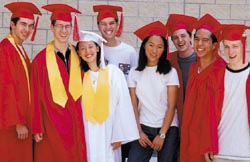
It’s 7:55 on a sticky June morning, and the students in Jonetta Russell’s research class are already at work. One by one the 17 juniors describe for the class the projects they will be working on during the summer ahead. Most of the precocious teen agers have secured internships at one of the many blue-chip scientific institutions in the vicinity of Silver Spring, Maryland, where Montgomery Blair High School is located, and the range of disciplines is impressive: nuclear medicine, superconductors, neuropsychology.
 But Russell’s focus is less on the scientific details of the projects and more on other matters. When Albert Mao describes his work calibrating a new PET scanner at the National Institutes of Health, for example, Russell sidesteps the advanced algorithms he’ll be working with. Instead, she takes his presentation as an opportunity to discuss the culture of a scientific laboratory, and how technicians and post-docs fit into the hierarchy. “You need to become acquainted with the language of the laboratory,” she tells the class. When Navin Bhutani describes his internship at the Army Research Laboratory, working on wartime communications systems for Humvees, Russell brings the discussion around to the broader, civilian applications of specialized military research. All the while, she is pushing her obviously very bright proteges to clarify their thinking and their presentations, to be more precise in their use of language to describe their highly technical plans and accomplishments.
If history is any guide, one of these students—and perhaps more than one—will go on to garner national recognition in one of the many science and mathematics competitions in the year ahead. Last year, six students from the program—known officially as the Science, Mathematics, Computer Science Magnet Program—were among the 40 finalists in the prestigious Intel Science Talent Search, known as the Nobels of secondary school science. Montgomery Blair was the only Maryland school to place a finalist. Over the decade since the program has been eligible to compete, it has consistently been in the handful of top schools in the country, and it is the only school in the history of the competition to have three top-10 winners in one year.
Blair magnet students regularly bring home honors from other competitions as well, including the International Mathematics Olympiad, the Continental Mathematics League, and the International Computer Problem Solving Competition. Five Blair students recently won the Department of Energy National Science Bowl—and with it the opportunity to travel to Australia to mix and discuss scientific advances with the world’s top scientists. The list goes on.
 So how do they do it? It’s not simply that the program attracts the brightest and most highly motivated science and math students from around the county, though this is no doubt true (there are 800 applications for the 100 coveted slots in the magnet’s entering class). But such selectivity is typical of most science and math magnets around the nation, and few are as competitive as Blair year in and year out. An examination of Blair’s history and philosophy, and the way that philosophy is put into practice in classrooms like Jonetta Russell’s, suggests less obvious reasons for the program’s excellence—practices and attitudes that might be exploited by other science and math programs. For example:
Thinking vs. content.
The projects that Russell’s juniors were describing will become the crowning achievement of their four years at Blair. Beginning in their freshman year, all students are taught to focus less on memorizable content and more on the skills that make up good science—identifying problems, critical thinking, rigorous self-evaluation. Says Eileen Steinkraus, coordinator of the magnet program: “It used to be that you learned a body of knowledge and you were an educated person. Well, that’s not true anymore. Today you need to learn how to learn, how to solve problems. The easiest thing to do is say, ‘Memorize this information and give it back to us.’ But that’s not learning how to think.”
She concedes that it’s often a major adjustment for incoming students, because they’re used to a certain kind of homework and classwork and they find that none of the old rules apply. “They have to learn that there may be no right answer, or that there are four or five right answers. It’s frustrating for them, but it’s a creative frustration.” To ease this transition, Steinkraus says, the program deliberately enlists faculty members who are themselves comfortable with the ambiguity of the scientific process, who are comfortable with not knowing the correct answer, or even with being wrong.
Which is not to say that the students ignore content entirely. They don’t. But even course content is organized differently. The idea is that the world is not broken down into tidy categories, so the curriculum ought not be either. So freshmen may learn a concept from physics—the structure of the atom, for instance—then build on that knowledge the next year by studying organic chemistry, followed by the chemical nature of the universe in junior year earth science and, finally, the biosphere in senior year biology class. To underscore this intermingling of disciplines, teachers routinely visit and participate in other teachers’ classes, and students keep a single detailed journal of their progress—rather than the traditional binders for biology, chemistry, earth science, and so forth.
This kind of integration also requires an adjustment, according to the program’s founding coordinator Michael Haney, who left in 1992 to join the National Science Foundation: “Parents sometimes complain about this approach,” he says, “and we say, ‘That’s right, the students won’t complete physics until they’re done with biology.'” But this approach eliminates redundancy and, more important, gives students a more accurate way of thinking about knowledge and the world.
Emphasis on the practical.
When Russell talks to her students about the language and culture of the lab, it is part of a programwide effort to inculcate skills and attitudes that are essential to most high school science students but are rarely available in standard textbooks. All students are required to document every step in their thinking and research; they also learn to write proposals, as they would have to if they were competing for research funding in the real world.
In fact, Steinkraus says, sophomores participate in a class called Mission Possible, which requires not only scientific sophistication but business savvy as well. The students identify a problem, do a mock-up, and submit a proposal, but they act as if they were in a corporate environment, with only limited funding. Other students then evaluate the proposal, not only for its scientific viability but for real-world practicality as well. Similarly, junior year students participate in an engineering project, where in addition to the actual science and math they have to do patent searches, just as they would if they were working for an engineering firm. The idea, Steinkraus says, is to teach certain life skills—collaboration, personal responsibility—but also to keep the kids’ heads out of the clouds, to convey that science is not an elite, rarefied intellectual pursuit, but one that has to do with solving the real problems of real people.
This point of view is reinforced by the demographics of Montgomery Blair High School and the surrounding community. The eastern part of the county is lower to lower-middle class, ethnically and racially mixed, and the high school reflects that diversity and socio economic background. Steinkraus and her colleagues consider this a plus and have tried to capitalize on it, and she believes that much of her students’ success derives from being part of the larger school community—not an elite enclave where the privileged contemplate abstract problems of little relevance to others. When the high school moved into a new building last year, the magnet students argued for integrating the magnet classrooms as much as possible into the main school rather than isolating it in a wing of its own, as it had been before. And magnet students are regularly involved in educational activities in the surrounding community—teaching computer and Internet skills to local residents, for instance. Steinkraus says her students often return from their first college semester a bit disillusioned by the elitism and lack of diversity they encounter after Blair.
Writing and talking.
Numbers and symbols may be the lingua franca of science, but words, sentences, and paragraphs are the keys to scientific excellence. That is the philosophy at Blair, where communication is emphasized from day one and throughout the curriculum. As in Russell’s class, students are pushed to explain their ideas and work in terms that can be understood not only by scientists but by children. Such oral dexterity is key to competing in Intel and similar competitions, and later in the real world of science. Writing is also emphasized throughout, from freshman research logs and project proposals to resumes and the final, precisely prescribed poster board summarizing the senior project.
Administrators and teachers alike give great credit for the program’s success to Blair’s English department. The best scientific ideas will be wasted, Russell says, if the scientist can’t convince the world that the project is worth doing—or explain its social value once it’s done. And in the competitive world of science, she adds, it’s often a difficult pitch to make: “These kids know science,” Russell says, “but they’ve got to learn to sell ice cubes to Alaskans.”
Wray Herbert is a senior writer at U.S. News & World Report.
Category: Features