 Engineering Education
Magazine
Engineering Education
MagazineJolly Good Fellow

By Thomas K. Grose
Noel Sharkey’s academic career path has crisscrossed an impressive range of disciplines: engineering, computer science, philosophy, and psychology, among them. But it’s for his work in robotics that he’s best known. Indeed, the University of Sheffield computer science professor is arguably the United Kingdom’s most famous robotics expert—thanks to the power of the “telly.” For years, Sharkey was chief judge on the popular BBC TV series Robot Wars, which featured robots battling it out in gladiator-style tournaments. “It gives me a lot of street cred with the kids,” Sharkey says of the show.
And that’s important to Sharkey these days. Although he remains a busy researcher and academic—he also edits three academic journals, including Robotics and Autonomous Systems—much of his time is now spent popularizing engineering and science. As the senior media fellow for Britain’s Engineering and Physical Science Research Council (EPSRC), “my job is to engage the public through science and engineering,” he explains. Sharkey’s mission is to raise public awareness that science and engineering are not only crucial to society and its future, but they can be fun and interesting, as well. And he focuses primarily on youngsters.
That’s a critical audience in a country where enrollments in engineering nose-dived some years ago and have since remained flat. According to Britain’s Engineering and Technology Board, engineering enrollments at U.K. universities peaked in the early ’90s at around 21,000, then fell to around 15,000 or 16,000, where they’ve since remained. But during roughly that same period, overall university enrollments jumped 40 percent. And while students have been drawn to some areas of engineering, like civil engineering, other disciplines, especially electrical, have continued to slump since the bursting of the IT bubble a few years ago. At Sheffield’s computer science department, enrollments are down by two thirds from a couple of years ago. That’s alarming because, as Sharkey notes, “we were the cash cow.” He fears the decline results from engineering “being seen as very dull and boring.” That’s not only a worrisome perception problem but a potentially dangerous one, he adds, given that in developing countries like India and China, engineers are seen as heroes and engineering schools’ classrooms are bulging with eager students.
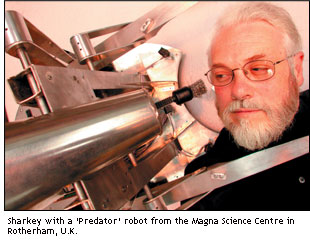
That’s why Sharkey thinks shows like Robot Wars are valuable—they help kids see engineering as something cool. The teams of “geeky kids” who built the warrior robots “turned out to be role models.” The program received only several dozen contestant applications in each of its early seasons; by its fifth year, however, it was regularly receiving several thousand applications—an indication that geek-chic can take off.
Rachel Bishop, EPSRC’s public engagement manager, says the council is delighted with Sharkey’s work so far. In Sharkey, she says, with his engineering and science know-how and his flair for showmanship, the council thinks it has found the perfect person to bring science and technology to the masses. “Noel is an ideal ambassador,” Bishop says. “He has a unique talent for getting people enthusiastic about robotics research. Noel’s charismatic approach to engaging people with science is exactly what our senior media fellowship scheme is all about.”
From Rough Road to Robots
Sharkey, who turns 57 this month, certainly knows something about being bored in school. He grew up in a working-class area of Coleraine, Northern Ireland, when the local schools were less than desirable. “I went to a crap school,” he recalls. Few of the teachers were qualified, “and they hit us all the time.” At home, however, Sharkey was very studious. His father—who died when Sharkey was 11—was an invalid who constantly had books delivered from the library, and he shared them with his son. But in the sterile, uninspiring atmosphere of his school, Sharkey showed little inclination to achieve, and his teachers considered him a dolt. When he was 14, his headmaster laughed at him when he said he played chess. He wasn’t laughing after Sharkey beat him in a match in front of the entire class. So bored was Sharkey at school, he tended to be a troublemaker. “I was a nightmare, actually,” he says. “When I left, no one complained.” And he was only 15.
Sharkey, today, with his trim white beard and long white hair neatly pulled back in a ponytail, looks not unlike an aging rock star. And that’s not far off the mark. Although he held down a variety of menial jobs after leaving school, he was an accomplished guitarist who played in number of rock bands. Eventually, Sharkey—who has always been interested in psychiatry—trained as a psychiatric nurse. Then a girlfriend, who was taking qualifying exams for college, urged him to take them, as well. “The minute I started, it just felt right. And that came as a surprise to me.”
Ultimately he got an honors degree in psychology at Exeter University and went on from there to study computer science. Next came research stints at Yale and Stanford universities in the United States and a return to Exeter where he researched linguistics in the computer science department.
Although his Ph.D. is in experimental psychology, Sharkey is a chartered electrical engineer and a fellow of the Institution of Electrical Engineers, as well as the British Computer Society. Given his interests in areas as diverse as cognitive science, engineering, computer science, and linguistics, it’s not surprising that he gravitated toward robotics. Sharkey built his first robot in 1989: a machine that could scoot down corridors, avoid people, and turn corners.
One of his more recent robots, eMo, which has red rubber tubing for lips and camera lenses for eyes, has an expressive face and can mimic such human emotions as happiness, sadness, anger and surprise. It greets and delights visitors at Thinktank, a science museum in Birmingham. One of Sharkey’s main research interests is how humans interact with robots; others include biologically inspired robots, cognitive processes, and machine learning. He met his third wife, Amanda, while an undergraduate at Exeter. She’s now a senior computer science lecturer at Sheffield, where she also focuses on robotics, and they’ve written a number of papers together. Sharkey also has five daughters, ranging in age from 38 to 11.
Though clearly besotted by robots, Sharkey thinks there are limits to what robots can accomplish. He scoffs at the notion that robots will ever be consciously aware. His own eMo can only mimic emotional expressions. Yes, he’s suitably impressed by advanced robots like Sony’s Qrio, a robot “companion” that can walk, climb (and descend) stairs, dance, recognize voices and faces, converse and express “emotions” using movement, expressions, and lights. But no robot can truly think or feel, he says. “Basically, they’re totally stupid.” Humans, Sharkey says, “are biological machines, and the word ‘biology’ is key to me.”
A Better Mix
Clearly, though, robotics is on the verge of making some stunning breakthroughs. But Sharkey fears that the United Kingdom could be left behind if its students continue to shun engineering and science.
He thinks one reason for the decline is the way engineering is taught in the United Kingdom, with a heavy, early emphasis on theory and math. “Kids come in and they want to design and build cars, but instead they’re fed theory and hard math. And they say, ‘What the heck is this?’” Degree programs should be made more palatable and exciting early on, Sharkey says, with more hands-on learning to go along with the theoretical so students can more easily see how it relates to real-life applications. “We need to get out the idea that engineering can be creative—and then make it so. Somehow, we need to teach innovation.” But Sharkey also realizes that few schools have either the time or the money to reshape their curricula. “So we could use a government initiative.”Sharkey also takes a more long-term view toward revitalizing engineering enrollments, noting that it’s best to capture the imagination of budding engineers when they’re as young as 10 or 11. Toward that goal, and with EPSRC funding, he runs a series of robot-control and construction competitions for children and young adults. A recent one was in Rotherham, a hardscrabble area outside Sheffield. About 2,000 inner-city kids made and took home simple cardboard robots from kits he devised that use a photoelectric sensor. Many of these kids are considered unteachable, “but to me, they seemed happy to learn. They didn’t see me as a teacher.” Moreover, constructing robots engages and entertains youngsters, which makes learning easier.
Schools, Sharkey believes, need to accommodate students who don’t necessarily do well using the one-size-fits-all model of learning from books and classroom discussions. Sharkey worries that too many disengaged, and thus undiscovered, smart kids are falling through the cracks. He recalls boyhood friends who were as smart or smarter than he was who never learned how to learn and have been largely unemployed their whole lives. “I was just lucky, really,” he says. Schools find it easier to deal with gifted students, but they’re mostly children from middle-class backgrounds whose parents push them to excel. The naughty kids may be just as bright, Sharkey says from experience.
But we need to find new and less traditional ways to reach and teach them.
Thomas K. Grose is a freelance writer based in London.
Category: Features