 Engineering Education
Magazine
Engineering Education
MagazineA World-class Act
By Thomas K. Grose
ENGINEERING STUDENTS ARE TRAVELING FAR AND WIDE TO IMPROVE THE LOT OF SOME OF THE WORLD’S POOREST COMMUNITIES.
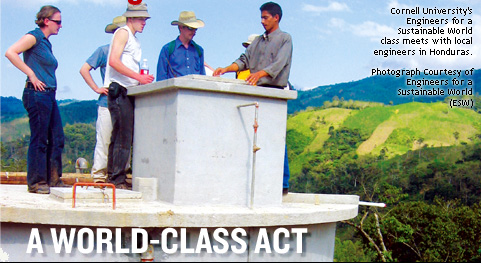
LAST JANUARY, Dale Meck, then a senior civil engineering student at Cornell University, found himself deep in the interior of Honduras at the end of the rainy season, slogging through mud that was, at times, up to his knees. Meck, 22, was there with six other students and two engineering faculty members to assist a local group working to bring water to remote villages. The Cornell contingent designed software that can be used on the fly in hardscrabble areas to estimate the cost and feasibility of planned water-supply systems: a money-saving application for communities where money is even scarcer than clean water.
That real-world project is one of many ongoing efforts organized by Engineers for a Sustainable World (ESW)—formerly known as Engineers Without Frontiers—which holds its national conference this month at Stanford University. The Honduras project is also one of four that form the nucleus of a new Cornell engineering course, entitled Engineers for a Sustainable World, taught by assistant professor Rachel A. Davidson, who also journeyed to Honduras.
ESW is a three-year-old, fast-growing organization that pools the resources of student, academic, and professional engineers to bring first-world technological solutions to third-world problems. Those problems are in areas such as potable and wastewater systems, infrastructure, information technology, housing, energy, and agriculture.
Ours is a world in which 5 billion people survive on less than $3 a week, and 1.2 billion don’t have access to clean drinking water. But, says Krishna S. Athreya, head of the ESW’s board of directors, “a lot of those conditions can be alleviated with appropriate access to technology.” Bringing useful technology to the developing world will not be easy. But, she asks, who’s better suited to the task than engineers. “They’re quintessential problem-solvers.”
Engineers Without Frontiers originated in Canada in 1999. The following year a branch opened in the United Kingdom. Athreya (who until recently was director of Minority and Women’s Programs in Engineering at Cornell) and graduate engineering student Regina R.L. Clewlow—now executive director—organized a chapter at the Ithaca campus in 2001 and began cobbling together the infrastructure for a national group. New chapters at campuses ranging from Penn State to Stanford emerged soon after. The group now has more than 1,000 members in chapters at 19 American schools, including the universities of California-Berkeley, Michigan, and Iowa. Clewlow estimates that by next spring, membership will total between 1,500 and 2,000. So far, membership tilts toward the civil, environmental, and mechanical fields, Clewlow says. But engineers from all disciplines are welcome and needed.
While the U.S. group maintains links to its counterparts in Canada and the United Kingdom—they often share resources—it’s taken a more independent route. The name change, for instance. The Americans decided Engineers Without Frontiers invited comparisons to groups such as Medecins Sans Frontieres (Doctors Without Borders) and Registered Engineers for Disaster Relief—organizations that parachute into emergency situations to provide aid. That’s not what this group does. The name Engineers for a Sustainable World, the membership felt, better described its more “long-term” focus on seeking “lasting solutions for reducing poverty.”
Engineering has always been about making life better, Athreya explains. “The core value of engineering is using technology in the service of humanity.” But, she adds, “When we talk about humanity, we mean all humanity, not just the privileged people who already have access to technology.” She speaks of the pyramid of humanity, where at the base live the 4 to 5 billion people who have little wealth; at the top live the relatively few rich. Usually, she says, the business model has been to develop technology for those at the top and let it filter down to the masses. ESW proposes developing technologies specifically designed for the world’s poor. These basic products and services would necessarily be inexpensive, but the “sheer numbers” of users would ensure massive markets that could generate profits, “turning the marketing model on its head.”
Narrowing the Gap
The organization is eager to bring sustainable development issues into the classroom. One of its goals is to “educate a generation of engineers to have greater understanding of global issues and the ways technology can be employed for human progress.” Many students are receptive, Athreya explains. “It’s a way to harness the idealism we have in youth.” The numbers bear her out: 84 percent of ESW members are students and 16 percent are professionals, including many academics. Moreover, she adds, helping the impoverished to have a better life can, for students, “be a life-changing experience.”
That was certainly the case for Meck. He says the trip to Honduras was an eye-opener. Even in small villages, he says, the gulf between the privileged few and the many others with nothing was huge. The Cornell group worked with a local organization, Agua Para el Pueblo, that’s building the water systems. Says Meck: “The coolest part is: It’s Hondurans helping Hondurans.”
Studies show that qualified young women often shun engineering for other fields, such as medicine, because many of them want to do something to help others, and they don’t see how they can accomplish that as engineers. That’s a misconception that needs to be overcome, Athreya says. “Engineering is all about helping people, and the scale can be quite grand.” She thinks efforts to give budding engineers the opportunity to tackle global poverty issues is one way to get that message across to not only young women but to minorities, as well. ESW membership figures indicate it is popular with women and minorities. Forty-one percent of its student membership is female and 17 percent underrepresented minorities. Among its professional members, 31 percent are women and 8 percent minorities.
Ideas for projects come from a variety of sources. Some percolate up from chapters and individual members, others come from activist organizations looking for engineering skills. ESW has a projects team that vets all suggestions. Its ongoing or completed projects include:
- Training IT trainers in Bosnia-Herzegovina in the intricacies of introductory Java programming.
- An irrigation cost study for sub-Saharan Africa.
- An effort in Nigeria to develop products and markets for energy converted from biomass waste.
Some new engineering courses, like Davidson’s at Cornell, are specifically designed to take advantage of ESW projects. In addition to the Honduran rural water project, Davidson’s class is also working on several other ESW projects, including an initiative to use vegetable oil as an alternative vehicle fuel, and the designing of a solar-powered oven. “They’re all technologies for the developing world,” Davidson says. The elective class has been popular not only with engineering students but with students from other departments. Also, women usually make up half the class roster.
Instead of creating new courses, some schools have incorporated ESW projects into existing courses. One civil and environmental course at Stanford is working on a “green” building design project. Other schools have developed seminars connected to projects.
Not all projects require travel to far-flung regions, and when travel is involved, not all participants need go. When a project is part of a class, however, students earn credits. For students and professionals alike, the project experiences can enhance one’s professional experience. They also look great on a résumé. One undergraduate student wrote a paper based on her experience working on a water project in India that was ultimately published.
In building the initial infrastructure of Engineers for a Sustainable World, Athreya and Clewlow focused on linking universities; an academic network seemed a logical way to proceed. The group is conducting a survey of professional engineers, members and nonmembers, as a first step toward bringing more professionals into the fold. Most current professional members are young. Many are former student members. Clewlow says EWS also plans to seek more corporate financial help. Funds come from many sources, such as individuals, funding agencies, activist groups (like the International Water Management Institute), student fundraising, and universities.
Meck, meanwhile, made one more project-related trip to Honduras this past summer. Of the experience, he says, “The main thing was [that] I felt like I was doing something special.” He begins work toward his master’s degree in hydraulic fluid mechanics at Stanford this month. He loves research and might remain in academia, but now he’s keen to combine his lab work with his new interest in sustainable development. “I’d like to target research that’s beneficial to more areas than the United States,” he says.
And it seems likely that the fruits of his laboratory labor will be in great demand.
The Web site for Engineers for a Sustainable World is www.esustainableworld.org.
Thomas Grose is a freelance writer based in Great Britain.
Category: Teaching