|
|

- By Wray Herbert
A fascinating recent book tells the story of
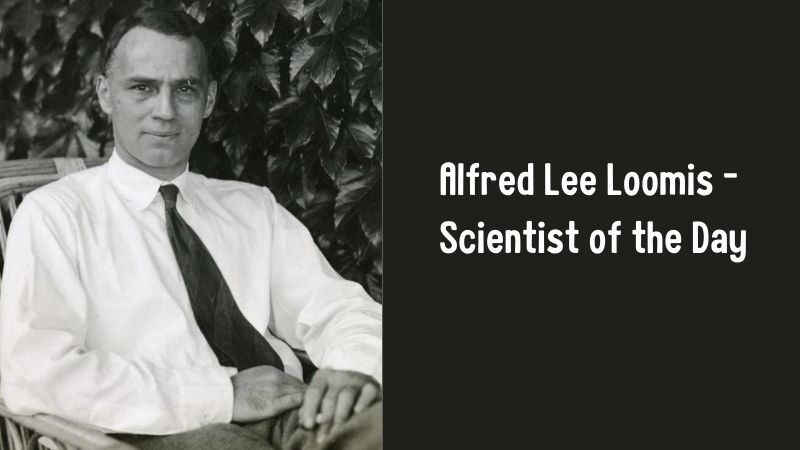
Alfred Lee Loomis, a visionary who set up a world-class private lab
that laid the groundwork for detection technologies that changed
the course of World War II.
Jennet Conant opens Tuxedo Park—subtitled "A
Wall Street Tycoon and the Secret Palace of Science that Changed the
Course of World War II"—with a seemingly tangential account
of her great uncle's suicide. William Richards was a failed scientist,
at least by his family's high standards. Son of a Nobel Prize-winning
chemist and brother-in-law of the acclaimed scientist and Harvard University
president James Conant (the author's grandfather), Richards went
into science more out of obligation than passion. Indeed his real passion
was writing, and when he took his life on January 30, 1940, it was
the publication date for his first novel, called Brain Waves and Death.
The book was a thinly veiled account of a real-life
laboratory located about 40 miles north of New York City, in the tony
community called Tuxedo Park, the nation's first gated community
and home to aristocratic families with names like Astor and Juilliard.
This lab is the "secret palace of science" of the subtitle,
and the Wall Street tycoon who funded it was Alfred Lee Loomis, arguably
one of the most significant and uncredited figures in the history of
modern military science. Loomis, a world-class tinkerer in his own
right, was a visionary who saw that technology would win the looming
war—and indeed that an investment in "big science" would
be the key to national strength in the future.
That Loomis is all but unknown today is remarkable and
unfortunate given his talents and contri-bution to history, and Conant's
readable and thorough account should go a long way in correcting that.
Loomis was born into privilege: Yale undergraduate, Harvard law, and
on to the prestigious Wall Street law firm of his uncle Henry Stimson.
(His cousin was Henry Stimson, secretary of war under Franklin Roosevelt,
a connection that would later prove important.) He made a fortune in
the 1920s raising capital for the emerging electrical power industry
(a future he also envisioned before most). He also looked around and
noticed that the stock market was overvalued, so he pulled his amassed
fortune out just before the crash of 1929.
So, as the country headed into the Great Depression,
Loomis was a fabulously wealthy man. But he was bored with the world
of finance (and disgusted with what he saw as FDR's intrusions
into the marketplace), so he retired from that world. For a while he
indulged in cars and yachts and even bought Hilton Head Island in South
Carolina as a personal hunting retreat. Then he turned to his secret
lifelong passion: physics.
Loomis was not a stranger to applied science. As a lieutenant
colonel during World War I, he had worked on war-related technologies
at the Aberdeen Proving Ground in Maryland. He was obsessed with improving
existing artillery and weaponry, and worked on a recoilless cannon
and armored tanks, among other things. His most important contribution,
however, was the "Loomis chronograph," for which he and
the U.S. Army shared a patent. This device allowed the precise measure
of the velocity of shells and vastly improved the accuracy of artillery.
As the director of R&D at Aberdeen, Loomis had had
the opportunity to work with many of the best minds in physics and
applied science (including Thomas Alva Edison, already a legend by
that time). These associations and the rewarding military work sparked
in Loomis a passion that would be lifelong. Even while working as a
Wall Street financier by day, he would commute home to Tuxedo Park
in the evening to tinker with various projects, including an improved
fire extinguisher and a specialized slide rule for calculating securities
(the Patent Office rejected his application). But far and away his
most consuming and successful work was on what we now call ultrasound.
Sound Research
One of the prominent physicists Loomis had gotten to know at Aberdeen
was Robert W. Wood, who was interested in possible uses of high-frequency
sound. Following the war, the two started a longtime collaboration.
It was a mutually beneficial relationship, with Wood acting as scientific
mentor and Loomis as eager student and benefactor. Together the two
developed a new oscillator (no expense was too great for Loomis's
world-class Tuxedo Park lab) and ran experiments that led to the publication
of several scientific papers in prestigious journals. In 1927, the
New York American ran the headline: "Super-Rays Discovery of
Rich Banker," detailing ultrasound's potential not only
for treating disease but also as "death rays." Even today,
some texts refer to Wood and Loomis as the "fathers of ultrasound."
The Loomis lab was by this time world famous. It was said to be better
equipped than any university lab of the time, and in fact, Wood often
commuted from Johns Hopkins University to carry out experiments that
he couldn't do at the university. Loomis started hosting scientific
conferences that attracted some of the most renowned scientists of
the world, including Niels Bohr, Werner Heisenberg, Enrico Fermi, and
of course Albert Einstein, who dubbed the lab "a palace of science." This
fame did not please many in the WASPy, clannish Tuxedo Park enclave,
Conant notes,and the rumors that circulated were tinged with anti-Semitism: "Strange
outlanders with flowing hair and baggy trousers were settling down
for weeks and months on end. They were performing all kinds of crazy
experiments—cooking eggs and killing frogs with sounds that nobody
could hear, clocking time to the ten-thousandth of a second, making
turtles' hearts beat in a dish, and similar enormities."
These "strange outlanders" were, of course, revolutionizing
modern science, and Loomis sensed the significance of their ideas.
He was also by this time greatly concerned about the war going on in
Europe, a war that he thought Germany would win with its advanced technology.
The United States was still officially neutral in 1940 when Winston
Churchill sent a delegation of scientists to Tuxedo Park to meet with
Loomis. They brought with them a collection of inventions—all
still on the drawing board—that the British government couldn't
afford to develop. Loomis was intrigued immediately by one device,
a so-called "resonant cavity magnetron," which had the
potential to revolutionize radar.
Since the government was unwilling to bankroll R&D for Europe's
war, Loomis himself started a radar laboratory at MIT. The "Rad
Lab" was funded by Loomis at the start, then later by foundations,
and it eventually had 4,000 people working on improve-ments in radar
technology. The sophisticated detection technologies that the Rad Lab
produced changed the course of the war, disabling the powerful fleet
of German U-boats, and also contributing to America's victories
in the Pacific.
It's been said that radar won the war, and the atomic bomb
finished it. It was inevitable that Loomis would eventually make the
acquaintance of Ernest Lawrence, who by the time they met had already
invented the cyclotron and was looking to build a massive (and very
expensive) atom smasher at the University of California–Berkeley.
They were an odd couple, Loomis the reserved, almost reclusive, east
coast WASP, and Lawrence the affable, wide-eyed midwesterner. Yet they
hit it off immediately and became fast friends. Loomis began splitting
his time between Tuxedo Park and Berkeley, where he worked side-by-side
with Lawrence on his nuclear physics projects and eventually arranged
the private funding (partly through his personal friend John D. Rockefeller)
for his cyclotron.
Making Connections
Loomis, more than Lawrence, was becoming aware that atomic physics
was more than pure science, that it might indeed contribute to the
development of weapons of unprecedented power that would be needed
to stop the Nazi menace. The well-connected Brahmin turned to perhaps
his most influential connection of all, first cousin and secretary
of war Henry Stimson, to argue the case that the government needed
to be involved in bankrolling cutting-edge scientific research for
the purpose of national defense. The government started hiring the
country's best physicists, many from the MIT Rad Lab. The subsequent
story of the Manhattan Project has been well told.
Once the government's bomb project was underway, Loomis shut
down the MIT Rad Lab. The radar innovations, however valuable, had
been superceded by interest in the ultimate weapon. At the end of the
war, Loomis also shut down the Tuxedo Park lab, and shuttered up the
Tudor mansion that had housed it. But that was at least in part for
personal reasons. It turns out that Loomis, whose wife was suffering
from severe depression, had been carrying on a longtime affair with
his lab chief's wife, a Belgian beauty. Eventually both couples
divorced, and Loomis married his mistress on the day his divorce was
finalized. The divorce and remarriage scandalized New York society,
alienating Loomis from both friends and family. He went into seclusion
and was rarely heard from again.
Loomis's story is compelling and long overdue. But Tuxedo Park
also offers a fascinating glimpse into the world of science between
the wars. This was a time when scientific research was strictly a privately
funded endeavor, indeed when amateurs like Loomis could make a contribution.
It's hard to imagine a private citizen today conducting military
research on his own dime. All of that was changing, of course, and
Alfred Lee Loomis was a central figure in the emergence of the "big
science" of today.
Wray Herbert is a freelance writer based in Washington,
D.C.
He can be reached at wherbert@
asee.org.
|