 Engineering Education
Magazine
Engineering Education
MagazineJanuary 2006 – Briefings
- SECURITY – CAREFUL, HE MIGHT HEAR YOU
- BOOK NOTES – BAD INFLUENCE
- EMERGENCY PLANNING – EASING THE PAIN OF WAITING
- AEROSPACE – FLIGHT TIPS FROM A FLY
- HIGHER ED – ACADEMIC MISBEHAVIOR
- RESEARCH – TEST DRIVE FOR NANOTECHNOLOGY
- COMPETITIVENESS – THE HIGH COST OF KEEPING UP
- IN MEMORIAM – THE MAN WHO MADE A DIFFERENCE
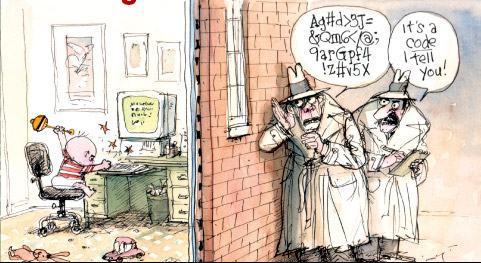
Careful, He Might Hear You
Bad guys using cheap audio recording equipment and armed with clever algorithms could be reading everything you write on your computer. Researchers at the University of California, Berkeley, say that audio recordings of keyboard clicks can be translated quite accurately into readable English, thus deciphering whatever is being typed, from top-secret memos to passwords. The Berkeley team, led by computer scientist Doug Tygar, used an algorithm to decode a 10-minute sound byte of someone typing. Tygar’s team was able to accurately decode 96 percent of the characters typed. “It’s a form of acoustical spying that should raise red flags among computer security and privacy experts,” Tygar says. Each keystroke makes its own fairly distinct sound. And a typical typist types about 300 characters a minute. That’s slow enough for a computer to isolate and decode each click. Using spelling- and grammar-check software and an algorithm designed to “learn” to correct mistakes after repeated listenings, a computer was able to accurately read 70 percent of the characters and half the words. But the researchers then re-fed a tape loop of the recording into the computer. After several listenings, it was able to decipher 96 percent of the characters and 88 percent of the words. —Thomas K. Grose
Bad Influence
 An innovative new idea is getting its first airing at a business meeting when a critical voice pipes up, saying he or she wants to play “devil’s advocate,” and then proceeds to take pot shots at the idea with impunity. Consultant Tom Kelly, in his new book, “The Ten Faces of Innovation,” calls the devil’s advocate the “biggest innovation killer in America today.” That matters because innovation is the lifeblood of corporations. Using examples from companies ranging from Google to Gillette, “Ten Faces” explains that innovation requires teamwork and that there are typically within any company 10 types of key role players, ranging from the Anthropologist, who’s an expert on how customers use products and services, to the Hurdler, who’s good at overcoming challenges. Teams that comprise all or most of the 10 personas are best able to protect good ideas from being shot down by a sniping devil’s advocate. —TG
“We have the best and brightest from all over the world who have built up our economy. Failing to recognize that is a big mistake.”
-EDWARD LEE, ASSOCIATE CHAIR OF UC-BERKELEY’S DEPARTMENT OF LECTRICAL ENGINEERING ND COMPUTER SCIENCES, IN RESPONSE TO NEW EDERAL PROPOSALS THAT PUT LIMITS ON FOREIGN SCIENTISTS
Easing The Pain Of Waiting
University of Maryland engineers have good news—you could call it a free shot in the arm—for county emergency responders and planners facing down the flu season and the threat of pandemics like the bird flu. Researchers at Maryland’s A. James Clark School of Engineering have developed software to help public health officials run the most effective and efficient vaccination clinics possible. The software can help officials design clinics and streamline processes so that the greatest number of people can be vaccinated as quickly as possible, which is especially important in a crisis situation. The software was developed after extensive time studies at training exercises for mass smallpox vaccinations and mass dispensing of antibiotics in case of anthrax. Jeffrey Herrmann, associate professor in the department of mechanical engineering and the Institute for Systems Research, developed the system and says the clinic planning model can help officials create emergency preparedness plans. Although clinic planning models are already available to help evaluate clinic capacity, Herrmann’s model is the only one to address congestion and line formation in mass-dispensing scenarios. Planners all around the country have been collaborating on the research and are using the software to design their clinics. Shots are still no fun, that’s for sure. But with streamlined plans for vaccinations clinics, at least the wait might be a bit less
painful. —Lynne Shallcross
Flight Tips From A Fly
Anyone who has tried to swat one of the little buggers will appreciate Rafal Zbikowski describing common houseflies as “extremely maneuverable flyers, the best of any species, insect or otherwise.” Moreover, they’re able to zip around using less computational power than found in the average toaster. That’s why Zbikowski, an aerospace researcher at Cranfield University’s Royal Military College of Science in England, along with biologists at Oxford and Cambridge universities, wants to crack the aeronautical secrets of flies.
So they’ve built a tiny IMAX-type theater with a panoramic screen and a tiny flight simulator. Flies will be strapped into the simulator, which will mimic the inertial effects of flight, while scenes of flight will flash on the screen. It may sound like a sublime way to torture flies, but no. Electrodes inserted into their brains will be able to monitor their neurons as they light up during the “flights,” allowing researchers to understand flight from their perspective. Any flying tips gleaned might be used to design micro-air vehicles, autonomous robots that copy insect flight. Wonder if the fly IMAX has a refreshment stand? —TG
Academic Misbehavior
TOKYO—In Japan, the term “teacher” has traditionally been a label of highest regard, but in recent years the occupation has been tarnished by revelations suggesting that academic misconduct is rampant in the country. The Science Council of Japan recently announced the results from a survey of 1,481 professional associations. With a response rate of just over half, the survey found 113 associations acknowledging problems of misconduct in the period from 1999 to 2004. “Considering this was a span of only five years,” the council noted, “the incidence of actual or suspected impropriety was relatively high.”
Misconduct is defined as a wide range of academic sins, including fabrication of data, falsified results and plagiarism. Less than one-fifth of those academic associations responding to the survey said they had established a mechanism and/or procedures for coping with transgressors. “Although the potential for misconduct is high,” the report concluded, “most associations have no means for dealing with it—a situation that must be rectified swiftly.” The leading daily newspaper, Yomiuri Shimbun, noted a range of cases have come to light in recent years, including one involving a pair of researchers at a physical and chemical research institute that doctored technical data in papers presented last year. Japan is closely studying foreign institutions including the U.S. Office of Research Integrity and is expected to adopt measures such as a code of ethics and the establishment of an “academic tribunal” to investigate and punish offenders. —Lucille Craft
Test Drive For Nanotechnology
Engineers at Rice University have succeeded in constructing the world’s smallest car. Surprisingly, though, it wasn’t inspired by the growing energy shortage. The car happens to be a single-molecule “nanocar” that measures just 3 to 4 nanometers across (slightly wider than a strand of DNA) and contains four buckyball wheels connected to four independently rotating axles and an organic chemical chassis. The creation is the result of eight years of research conducted by James M. Tour, professor of mechanical engineering and materials science, chemistry and computer science, and Kevin F. Kelly, assistant professor of electrical and computer engineering.
The car will provide critical insight into building structures molecule by molecule. Other research has come up with nanoscale objects shaped like automobiles, but the Rice team’s car is the first to also function like a car, rolling on four wheels in a direction perpendicular to its axles. With rotating axles and wheels rolling, the nanocar moves forward or backward instead of sliding back and forth, which is common on the nanoscale. The team also designed a light-driven nanocar and a nanotruck. The original research was funded by Zyvex Corp., a nanotechnology company in Texas, the Welch Foundation and the National Science Foundation. Honda is jumping in to help the researchers continue their nano studies by awarding them the Honda Initiation Grant, a prize worth $50,000. —Lynne Shallcross
The High Cost Of Keeping Up
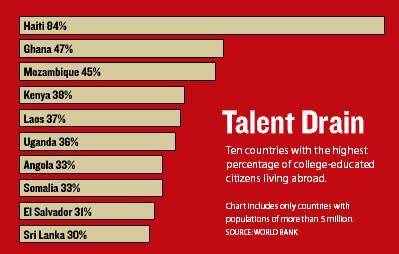
America’s economic vitality has given us a quality of life and sense of security unparalleled in history. And it’s been built upon innovation and new technologies. But a new report by the National Academies says all that is at risk unless great efforts are made—and very quickly—to re-hone the country’s competitive edge in science and engineering. The 20-member Committee on Prospering in the Global Economy of the 21st Century says it is “deeply concerned that the scientific and technical building blocks of our economic leadership are eroding at a time when other nations are gathering strength.” America faces two main challenges: creating high-quality jobs for its citizens and responding to the national need for new, clean, affordable and reliable energy. The panel came up with four key recommendations, as well as 20 specific suggestions, for reaching those goals. The four recommendations: increase the country’s talent pool by “vastly improving” K-12 science and math education; sustain and strengthen (read increase funding for) America’s traditional commitment to long-term basic research; make the country a global education magnet, the place to study, research and commercialize new technologies; ensure that the Unites States is the top place to innovate, invest and create jobs by overhauling patent laws, changing tax laws to encourage innovation and making broadband Internet access widespread and affordable. Total cost of implementing all 20 steps: about $10 billion a year. That’s a lot of cash for a deficit-ridden federal government. But, the commission argues, that investment would be dwarfed by the resulting economic payoff. —TG
The Man Who Made A Difference
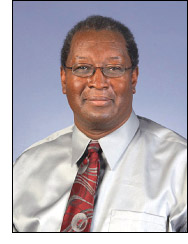
The importance of education was drilled into Isadore T. Davis almost from the time he was born. He grew up poor in a family of five children in Clarksdale, Miss. He and his siblings picked cotton to help support the family. The way out, his mother told him, was education. Davis graduated with honors from Jack Yates High School in 1966 and went on to earn an undergraduate degree in math from Prairie View A & M University and a master’s degree in engineering mechanics from Iowa State. Before moving to industry, he taught engineering at Prairie View. At the time of his death in late November, he headed the university relations program for Rolls-Royce—ironically one of the nation’s most identifiable symbols of great wealth. Education had played a crucial role throughout Isadore Davis’ life.
In addition to his job at Rolls-Royce, Davis served as the chair of ASEE’s Corporate Member Council, where he was instrumental in bringing in new members. He had been at ASEE’s offices in Washington, D.C., the day before suffering the stroke that led to his death. The role of the council is to help engineering programs produce quality graduates for industry, a mission that dovetailed with the work Davis was doing at Rolls-Royce. “Isadore played a key part in making the Corporate Member Council the strong body it is today,” says Bob Black, deputy director for the American Society for Engineering Education. Under Davis’ leadership, the council has grown from a handful to more than 30 active members. A passionate, outgoing man, Davis also improved communications among ASEE’s four councils making sure that the society’s executive board knew what was going on in each council. Those councils are now considering establishing an Isadore T. Davis Award that would be given for promoting the development of strong relationships between industry and education.
After Davis left his teaching position at Prairie View, he worked as a structural analyst for the next 17 years. He was project manager at numerous aerospace, Department of Defense and commercial companies. He held multiple posts at Hughes Missile Systems Co. Davis also led Raytheon Missile Systems (RMS) Engineering Effectiveness Metrics Program and managed, coordinated and implemented the RMS Engineering University Relations Program before moving to Rolls-Royce. At one time or another, Davis also taught at Huston-Tillotson College in Austin, Texas, and Pima Community College in Tucson, Ariz.
He was a man with many strong interests—his family, his community and his work in engineering outreach and minority education. He was actively involved in introducing students in grades six to 12 to the engineering profession. He was passionate about technology and believed that a technological education offered great career opportunities. He believed strongly in a more diverse engineering workforce and supported historically black colleges and universities. “Isadore was a man of great personal integrity and was totally fearless in pushing back against perceived management indiscretion. His work on behalf of minority students created great and long-lasting opportunities within Raytheon and other companies,” says Wayne Johnson, vice president of Worldwide University Relations at Hewlett-Packard.
At Rolls-Royce, he met almost daily with engineering students interning at the company. To be successful, he would tell them, you have to be a nosy engineer. Gather as much information as you can, he advised. “He got personally involved with students and really cared about them,” says Jay Snellenberger, a senior manager at Rolls-Royce who worked with Davis.
Davis was honored with many awards in his lifetime, including the Raytheon Team Achievement Award, the Mayor of Tucson Extraordinary Citizen Award, the University of Puerto Rico-Mayaguez College of Engineering Award and the U.S. Department of Justice Community Appreciation Award. “He was a good friend to engineering,” says ASEE Executive Director Frank Huband, “and he will be missed.”
Category: Briefings